写真準備中
初級
French
Classic French Omelette
出典: シェフ
10 分1300 kcal
ベジタリアングルテンフリー低糖質+1
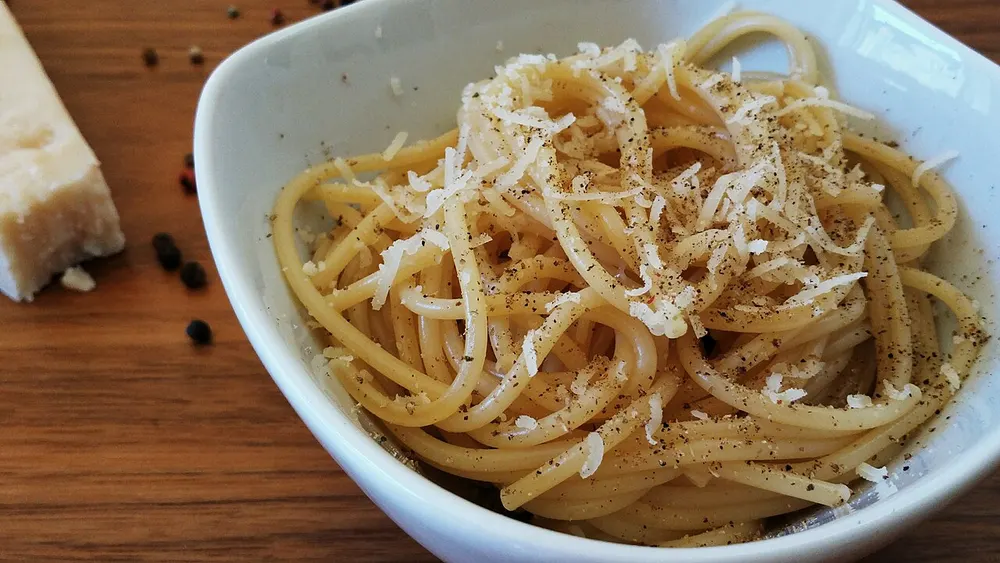
Three ingredients, nowhere to hide: pecorino, black pepper and pasta, bound into a glossy cream by nothing but starchy water and the temperature of your pan.
出典
レシピ提供 Roman home kitchens · 🏠 家庭料理 · Old Roman home cooking; quantities here follow GialloZafferano's published version
GialloZafferano — Quantities follow GialloZafferano — Italy's largest recipe site — whose published version for 4 uses 320 g of thick spaghetti, 200 g of medium-aged Pecorino Romano DOP and 5 g of peppercorns. Their recipe schema credits the masthead rather than an individual cook, so no personal attribution is claimed here. The dish itself is old Roman home cooking and belongs to nobody.
Watch it being made · 2 videos
Grate the whole 200 g of pecorino on the finest holes you own and keep it in a wide bowl.
💡 Fine grating is not fussiness — a coarse shred has too little surface area to melt evenly and will seize into strings.
Crush the peppercorns coarsely — a mortar, or the base of a heavy pan pressed down on them on a board.
Toast the crushed pepper in a dry pan over medium heat for about 1 minute, until it smells sharp and floral and you can feel it in your nose.
💡 This is where the dish gets its aroma. Stop the moment it smells alive — pepper goes from fragrant to acrid in about 15 seconds.
Boil the spaghettoni in a pan with less water than usual — just enough to cover them — and salt it lightly, if at all.
💡 Two reasons: less water means far starchier water, which is the only thing binding this sauce; and 200 g of pecorino brings all the salt the dish needs.
While the pasta cooks, ladle a little of the cloudy cooking water into the pepper pan and let it bubble down for a minute or two into a dark, fragrant infusion.
Ladle more of the cooking water into a small jug and let it cool for a minute, until it is warm but no longer scalding.
💡 Boiling water on cheese is the single mistake that ruins cacio e pepe: the proteins tighten instantly into rubbery threads. Warm water dissolves them.
Whisk that warm water into the grated pecorino a spoonful at a time, until you have a smooth cream about as thick as yoghurt. Add slowly — you may not need it all.
💡 It will look like wet sand before it looks like cream. Keep working it — that stage is normal and it passes.
Drain the spaghettoni about 2 minutes before the packet time and tip them into the pepper pan with a splash of their water.
Finish cooking the pasta in that pan over medium heat, tossing constantly and adding water a little at a time, the way you would feed a risotto. It is done when it is al dente and the pan is glossy rather than soupy.
Take the pan off the heat and wait 30 seconds — put your hand near the base; it should be hot but not fierce.
💡 This pause is the whole recipe. Cheese added to a pan still on the flame will scramble; cheese added to a pan that has calmed down turns into sauce.
Pour in the pecorino cream and toss hard and continuously, shaking the pan and stirring, until every strand is wrapped in a glossy sauce that clings.
💡 If it tightens or goes stringy, take the pan right off the heat and beat in a spoonful of warm water. Nine times out of ten it comes back.
Twist into warm bowls and finish with the last of the pecorino and a final crack of toasted pepper.
Serve at once. Cacio e pepe waits for nobody — it stiffens as it cools.
作ってみましたか?写真を「作ってみた」に投稿してください。
あなたの作品をシェア →