入门
Korean
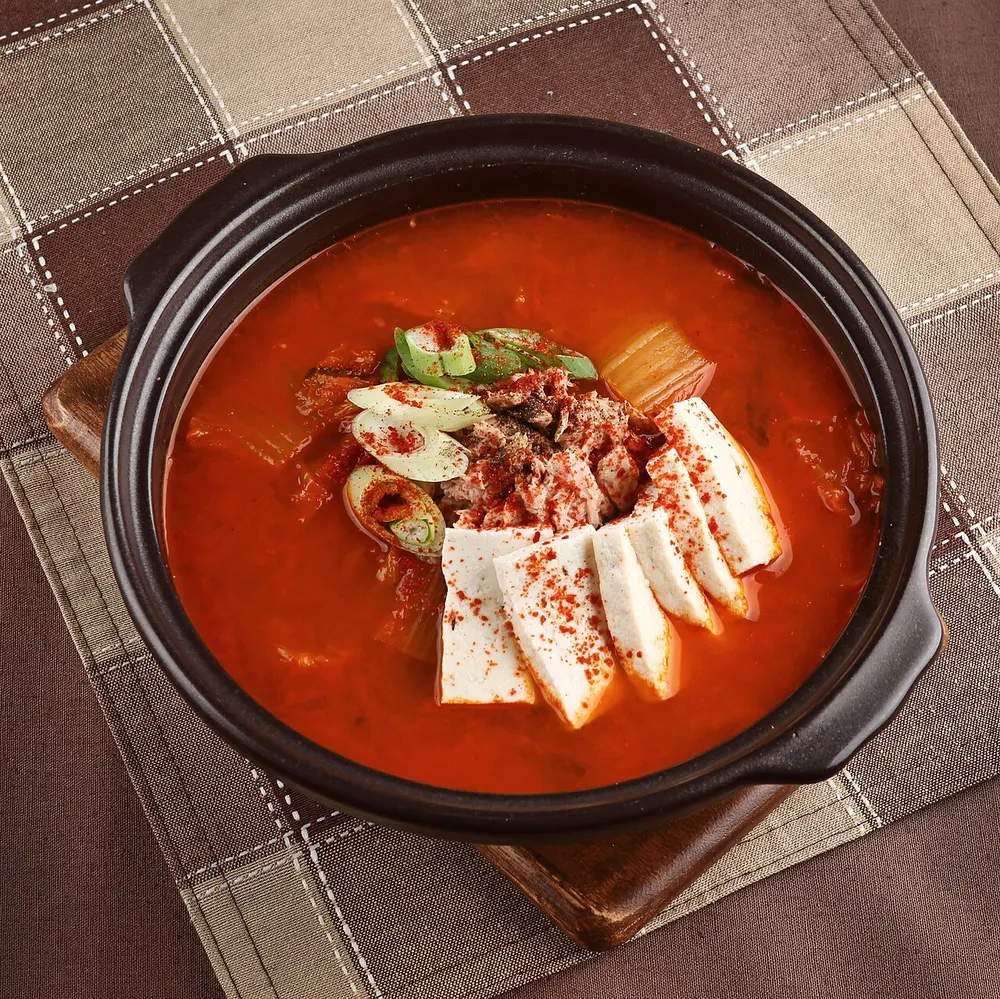
Kimchi Jjigae (Kimchi Stew)
来源: 传统
30 分钟3420 大卡
无乳制品🌶️🌶️
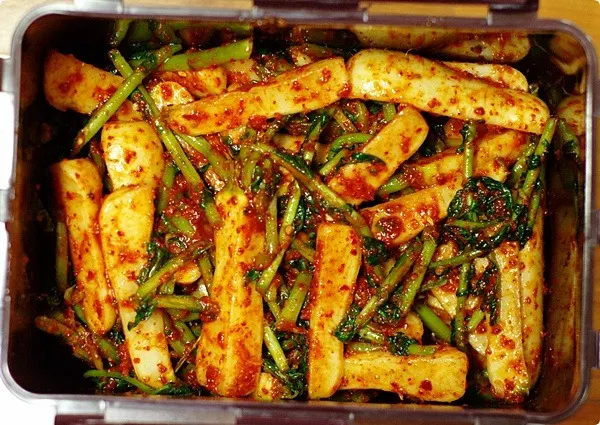
Her kimjang-season ponytail radish kimchi, and the first instruction is a refusal: do not peel them. The skin is where the snap lives. Chili SEEDS and ground anchovy go into the paste, and the sealed tub is what does the rest.
来源
食谱提供 강순의 · 👨🍳 主厨 · Kang Soon-ui — Korean kimchi cook; MBN's Altoran credits her on air as a kimchi 명인 (master), and she runs the YouTube channel 강순의 나주종가
厨师与创作者的姓名仅用于标注出处。More Recipes Please 独立运营,与他们没有任何合作、赞助或代言关系。
MBN Altoran (알토란) — cook's own published recipe — Published by MBN on 알토란's own channel (알토란 - 집밥 레시피, @Recipe_MBN) as a 김장 special; the description opens '알토란 412회 강순의 레시피 MBN 221115' and prints her ingredient list, her equipment list and her three numbered steps. Broadcaster-published text, not a viewer's write-up. What marks it: the radishes are explicitly NOT peeled, the paste carries whole chili seeds and ground anchovy rather than chili powder alone, stevia replaces sugar, and the tub is sealed against air. Gaps we flag rather than fill — her list gives no amount for the water or the chives, and 갓 is only quantified inside the method (반 컵). Her '풀국 2컵' has no recipe in this episode at all; the ratio used in step 3 is taken from her own Altoran 425회 and the scaling to 2 cups is ours, which is said plainly in the step and the ingredient note.
厨师: 강순의
Watch it being made · 3 videos
Trim the ponytail radishes: cut away any soil where the greens meet the root, but leave the skin ON.
💡 This is her first instruction and it is a refusal. Peeled radish loses its snap and goes limp in the tub — the skin is what keeps chonggak-kimchi crunchy for months. Scrub it, don't peel it.
Salt them with the coarse salt and leave them 5–6 hours — her figure.
💡 Test by bending one: it should flex without snapping. Under-salted radish will taste raw and push water out of your paste later; over-salted radish never regains its crunch.
Make the pulguk and cool it: whisk glutinous rice and buckwheat flour into water and heat it gently, stirring, until it thickens. You need 2 cups.
💡 Her kimjang episode calls for '풀국 2컵' but never says how to make it. The ratio here comes from her own nabak-kimchi episode (1 tbsp glutinous rice + 1 tbsp buckwheat to 1½ cups water); scaling it to 2 cups is our arithmetic, not her instruction. It MUST be cold before it meets the paste — warm paste ferments the batch before you have even sealed it.
Rinse the salted radishes and drain them properly in a colander. Cut each one into quarters — or to a comfortable eating size if they are big, as she says.
Drain them well. Chop the gat and the chives roughly — 듬성듬성, in rough lengths, not fine.
💡 Rough, not fine, and this is deliberate. Finely cut greens bruise, release their juice into the paste and go slimy over a long ferment; big pieces stay intact and keep their own texture for months.
In a large basin, stir together 4 tbsp chili powder, 2 cups of the cooled pulguk, 2 tbsp minced garlic, 1.5 tbsp chili seeds, 1 tbsp ground anchovy, ⅓ cup fish sauce and the stevia.
Let the paste sit a few minutes and look at it: the chili powder should have swelled and darkened from orange to deep red.
💡 That colour change is the paste blooming in the pulguk's moisture. Mix the radishes in before it happens and the kimchi ends up orange and thin-tasting instead of deep red — this is our sensory cue, not her instruction.
Fold the gat (½ cup) and the chives through the paste.
💡 Greens into the paste FIRST, radishes after. Doing it in this order coats every leaf; throw everything in at once and the heavy radishes take all the paste while the greens stay bare.
Add the quartered radishes to the basin and turn them through the paste until every piece — skin, root and greens — is coated.
💡 Wear gloves and use your hands, not a spoon. You need to feel when the paste has gripped, and a spoon will snap the ponytails off — which is the one part everyone actually wants to eat.
Pack it into the tub — she specifies an 8 L one for this batch — pressing down as you go so no air is trapped, and seal it.
💡 Her instruction is literally 'sealed so no air gets in', and she means it. Air pockets are where kimchi goes white and mouldy. Press the surface flat and lay a sheet of cling film right onto the kimchi before the lid goes on.
Leave it at room temperature just long enough to start — 살짝 익힌 후, 'once it has ripened a little' — then move it to the fridge.
💡 She gives no time here and that is honest of her — it depends entirely on your kitchen. Our guide: half a day to a day in a cool room, or until the tub gives a faint hiss when opened. Then cold storage does the slow work over weeks.
Eat it whole radish and all, greens included, cut across at the table with scissors. It is at its best from about three weeks in.
做过这道菜吗?在秀场分享一张照片吧。
晒出我的作品 →