入门
Korean
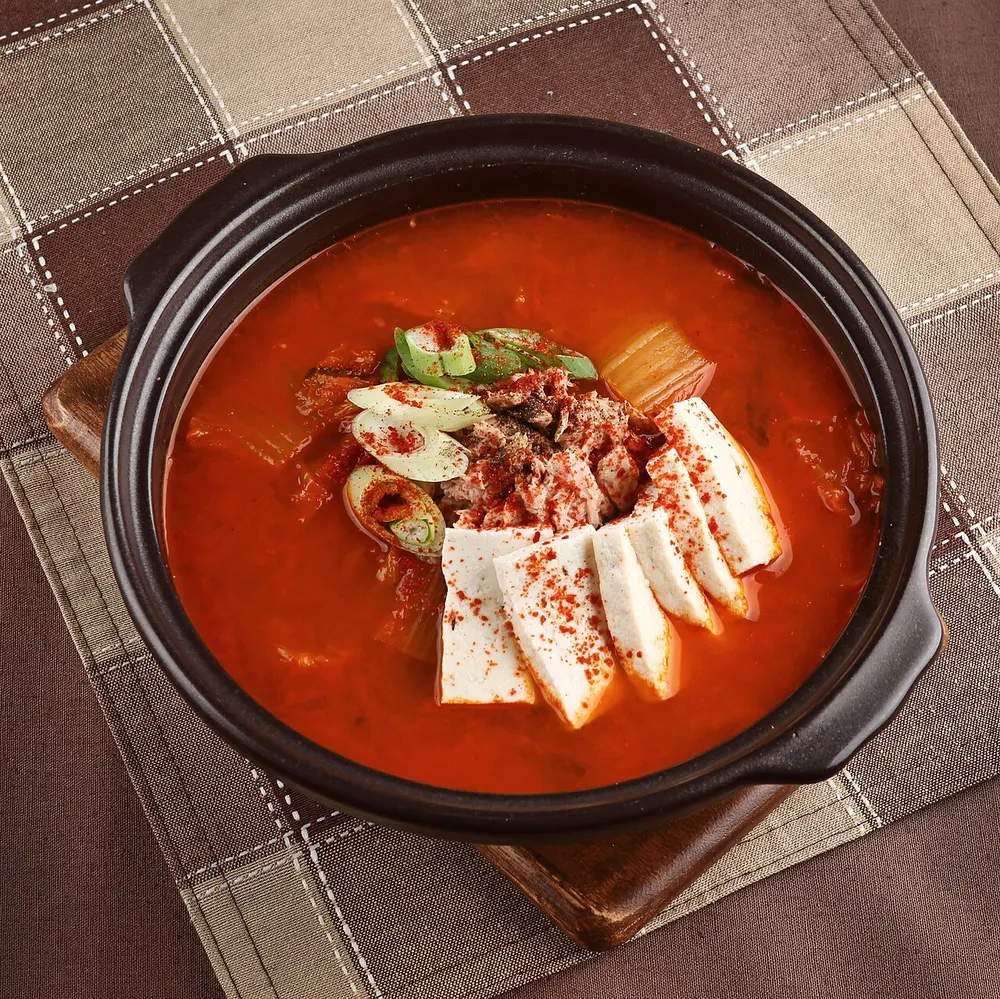
Kimchi Jjigae (Kimchi Stew)
来源: 传统
30 分钟3420 大卡
无乳制品🌶️🌶️
The hangover bowl, built from nothing: no stock, no bones, no hours. Pork and kimchi fried dry in the pot, water, a spoon of fish sauce, and half a bowl of rice boiled until the grains give up and fall apart.
来源
食谱提供 자취요리신 (simple cooking) · 📱 网红 · Korean YouTuber specialising in fast one-pot recipes aimed at people living alone; posts the written recipe under most of his videos
厨师与创作者的姓名仅用于标注出处。More Recipes Please 独立运营,与他们没有任何合作、赞助或代言关系。
Recipe published by 자취요리신 / 자취요리신이 공개한 레시피 — He publishes the whole recipe as text in this video's description, headed 삼겹살 김치국밥을 만들어 보자 and hashtagged 해장용 (for hangovers). Distinctive: gukbap normally means a long-simmered bone or pork broth, and this has neither — the depth comes from frying kimchi in rendered pork belly fat before any water goes in, plus a tablespoon of anchovy fish sauce and a quarter spoon of chicken stock powder. Total cooking time is about ten minutes. SERVINGS: he never writes a serving count. Our reading of 1 rests on his own 밥 1/2공기 (half a bowl of rice), 150 g of pork and 360 ml of water in one ttukbaegi — it is our inference, not his figure.
厨师: 자취요리신 (simple cooking)
Watch it being made
Set a ttukbaegi or small heavy pot over medium-high heat with no oil in it at all.
💡 No oil, on purpose. 150 g of pork belly renders more fat than you would ever add, and the kimchi is about to fry in it.
Spread the shaved pork belly across the base, separating the ribbons as you go, and let it fry.
Add the 3 spoons of cut kimchi and keep everything moving in the rendered fat.
Fry until the kimchi darkens from bright red to a deep brick colour and stops smelling raw and sharp. Two or three minutes.
💡 This is the step that replaces stock. Raw kimchi dropped into water gives you sour water; kimchi fried in pork fat first gives you something that tastes like it simmered for an hour.
Pour in the 360 ml of water. It will hiss hard — scrape the browned patches off the bottom with your spoon as it does.
Stir in the tablespoon of anchovy fish sauce and the quarter spoon of chicken stock powder.
💡 A quarter spoon is not a typo. Chicken stock powder is aggressive, and the fish sauce is already doing the savoury work — this is a top-up, not the seasoning.
Bring it to a full boil over high heat and let it go for a couple of minutes so the kimchi's sourness spreads into the water.
Add the handful of soybean sprouts, the half bowl of rice, the green onion and the chili.
Break the rice up against the side of the pot with your spoon so the lump separates into loose grains.
💡 Cold fridge rice goes in as one brick. Break it up now, while it can still move — once it starts absorbing broth, the middle of the lump stays a hard cold core.
Keep it boiling until the grains have gone soft and started to fall apart — his instruction is literally to cook it until the rice loosens.
The broth thickens slightly as the rice releases its starch — that faint cloudiness is the whole difference between gukbap and soup with rice in it.
Taste it. Kimchi varies wildly in salt and sourness, so this is the moment to add fish sauce a few drops at a time if it needs it.
The soybean sprouts should still snap — they only need the last few minutes, and that squeak is the point of putting them in.
Eat it out of the pot, hot enough to hurt. It is tagged as hangover food and that is exactly the temperature it wants to be.
做过这道菜吗?在秀场分享一张照片吧。
晒出我的作品 →