Débutant
Korean
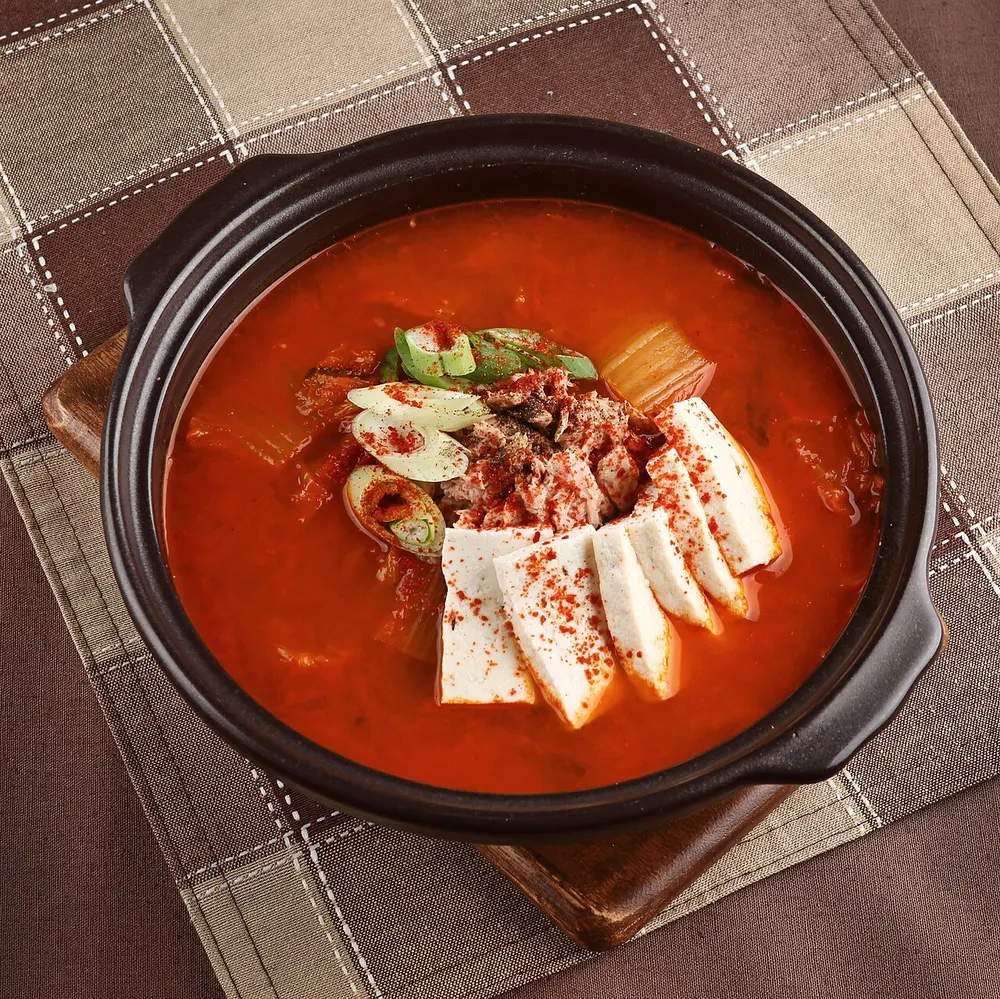
Kimchi Jjigae (Kimchi Stew)
Source: Traditionnel
30 min3420 kcal
Sans produits laitiers🌶️🌶️
A jijimi sits between a stew and a braise — thicker than soup, soupier than a side. Lee Bo-eun blanches young cabbage, coats it in doenjang before it ever meets the pot, and simmers it with seasoned beef in rice-rinse water for a full 50 minutes.
Source
Recette de 이보은 · 👨🍳 Chef · Lee Bo-eun — Korean cooking researcher (요리연구가), a recurring cook on MBN's Altoran
Les noms des cuisiniers et créateurs figurent uniquement à titre de mention de source. More Recipes Please est indépendant et n'est ni affilié, ni approuvé, ni sponsorisé par eux.
MBN Altoran (알토란) — Published by MBN on Altoran's own channel (알토란 - 집밥 레시피, @Recipe_MBN), whose description carries the full ingredient list and method and credits it as 'Altoran episode 341, eolgari-jijimi, #이보은'. This is the broadcaster's own recipe text, not a viewer's write-up. What marks her version out: the blanched cabbage is coated in doenjang before it goes into the pot, the single spoon of gochujang goes on the beef rather than into the broth, and she insists on the full 50 minutes — 15 on high, 35 on low.
Cuisinier: 이보은
Watch it being made
Trim the young cabbage: cut a cross into the tough root end so the heat can reach the core, then rinse it 2–3 times under running water until the water runs clear of grit.
💡 The cross cut is not decoration. Without it the stem end stays raw and squeaky while the leaves are already overcooked.
Bring a wide pot of water to a rolling boil over high heat and stir in 2 tbsp of coarse salt.
Blanch the whole cabbage for 3 minutes on high — her exact timing. It is ready when the thick stems bend instead of snapping and the leaves have darkened to a deep green.
💡 Three minutes sounds short for a whole cabbage, and it is meant to be. It only has to lose its raw grassiness — the pot still has 50 minutes of simmering to do.
Lift the cabbage straight into cold water and swirl it to kill the residual heat, then drain.
Squeeze the cabbage firmly with both hands until no more water runs out, then toss it with 3 tbsp of doenjang until every leaf is dull brown and coated.
💡 This pre-coating is the move that makes the dish. Doenjang stirred into a pot of broth just tastes of doenjang; doenjang worked into the cabbage first seasons the vegetable from the outside in.
Cut the beef sirloin into bite-size pieces and tap each piece lightly with the flat or back of the knife to loosen the fibres.
Mix the beef with 1 tbsp minced garlic, 2 tbsp matsul, 1 tbsp guk-ganjang, 1 tbsp sugar and 1 tbsp gochujang. Rest it while you cut the vegetables.
💡 Only one spoon of gochujang goes in, and it goes on the beef — not into the broth. It warms the colour and rounds the beef without turning this into a red stew.
Cut half an onion into thick julienne, slice one daepa on the diagonal, and cut the 2 Cheongyang chilies and 1 red chili into thin rounds. Keep the chilies aside — they are the last thing in.
Set a heavy pot over medium heat with 1 tbsp of perilla oil, add the doenjang-coated cabbage and stir-fry 2–3 minutes, until the oil smells toasted and nutty rather than raw.
Add the marinated beef, the 1.5 L of rice-rinse water, the julienned onion and the sliced daepa all at once.
Bring it up on high heat and hold it there for 15 minutes — her figure. Skim off the grey foam that surfaces in the first few minutes.
💡 Skim early or not at all. Once the pot has been rolling a while the foam breaks up and stirs back in, taking a muddy edge with it.
Drop the heat to low and simmer 35 minutes more — 50 minutes of cooking in total, exactly as she calls for. The broth should reduce and thicken slightly, and the cabbage stems should collapse when pressed with a spoon.
💡 This is the whole title of her segment — 무조건 푹 끓여야 제맛, 'it only tastes right if you simmer it right down'. Pulling it at 20 minutes gives you boiled cabbage in beef water, not a jijimi.
Scatter in the sliced Cheongyang and red chilies, let them go 1–2 minutes just until their raw smell lifts, then take the pot off the heat.
Taste before serving. Doenjang varies enormously between jars, so top up with a little guk-ganjang only if it needs it. Serve hot with rice.
Korean
Source: Traditionnel
Korean
Source: Cuisine maison
Korean
Source: Cuisine maison
Korean
Source: Traditionnel
Vous l'avez préparé ? Partagez une photo dans la Vitrine.
Partagez votre création →