Einsteiger
Korean
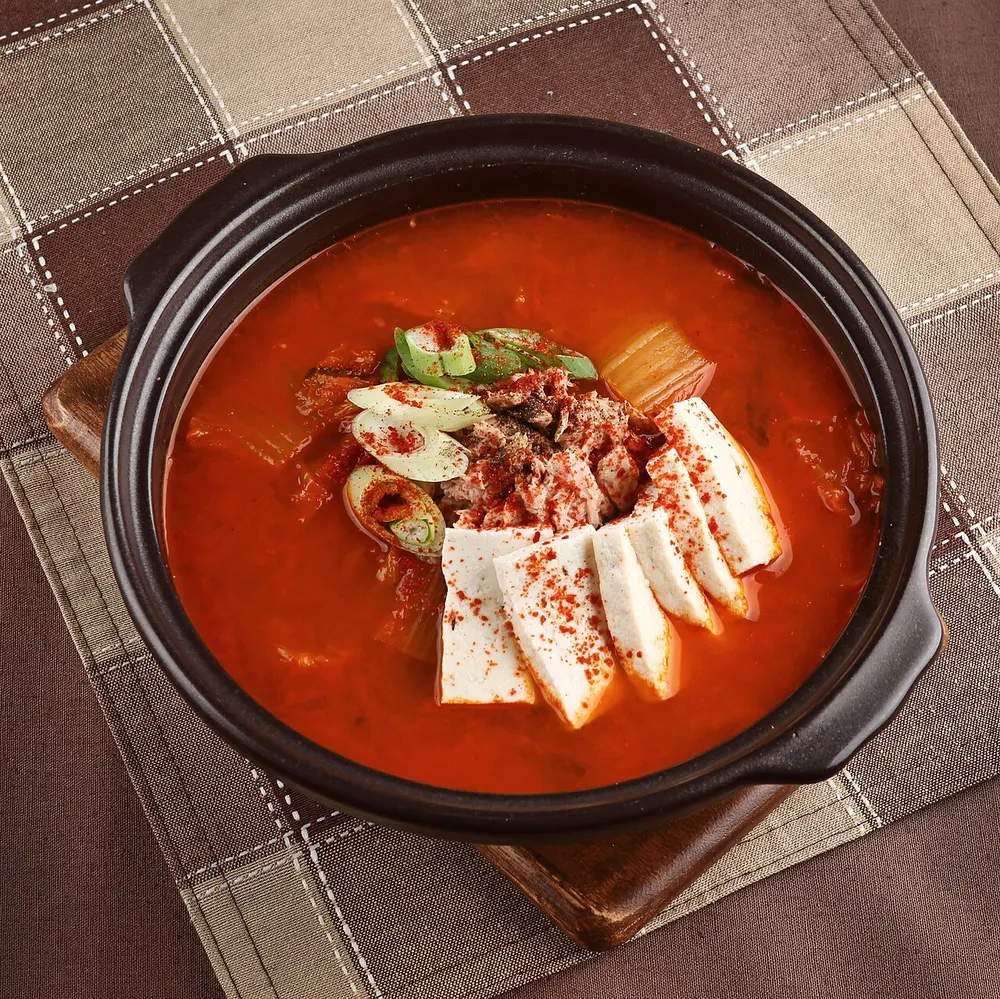
Kimchi Jjigae (Kimchi Stew)
Quelle: Traditionell
30 Min.3420 kcal
Laktosefrei🌶️🌶️
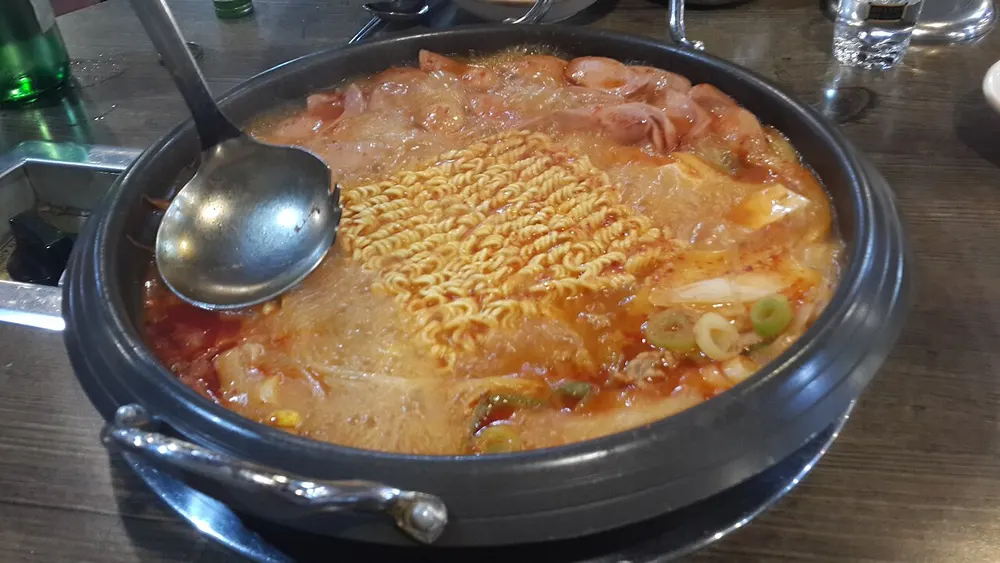
Army stew with no stock at all — a half-spoon of doenjang does the deep work — and one tin of ham cut three different ways so a small amount of meat fills the whole pot.
Quelle
Rezept von 백종원 · 👨🍳 Küchenchef · Paik Jong-won — chef & restaurateur, 백종원의 요리비책
Namen von Köchinnen, Köchen und Creators erscheinen ausschließlich als Quellenangabe. More Recipes Please ist unabhängig und wird von ihnen weder unterstützt noch gesponsert.
Paik Jong-won (요리비책) — Published by Paik Jong-won on his own YouTube channel as '🔥부대찌개🔥 육수 없이도 진한 맛 내는 방법!', which he says was the single most-requested menu from his subscribers; the description carries the full gram/ml table, his numbered method and an official English translation. Two things set his version apart: there is no stock whatsoever — a half-spoon of doenjang alongside the gochujang supplies the savoury depth — and the single tin of ham is cut three separate ways (sliced, julienned and hand-crushed) as a deliberate trick to make a small amount of meat fill the pot. He notes he used his own company's 백석된장 and 빽햄, while recommending traditional-style doenjang and a salty ham generally.
Koch: 백종원
Zubereitung im Video · 3 Videos
Halve the green onion lengthways and cut it into 4 cm lengths. Julienne the onion about 0.4 cm thick.
Slice one sausage 0.4 cm thick on the diagonal. Quarter the other lengthways and cut it into 3 cm lengths.
Now cut the canned ham three ways. Slice one third into 0.4 cm planks. Julienne the second third into 0.5 cm strips. Put the last third in a plastic bag and crush it flat with your palm.
💡 This is his trick for making a small amount of meat look like a lot. Planks read as generous slices on top, the julienne threads through every spoonful, and the crushed third dissolves into the broth and thickens it. Same 200 g, three different jobs.
Lay the green onion and onion across the bottom of a shallow pot, then arrange the sausage and ham on top of them.
💡 Vegetables underneath, meat above — this is a built pot, not a stirred one. The scallion cushions the ham from the direct heat of the base, and the pot arrives at the table looking arranged rather than dumped.
Add the seasoning paste ingredients — minced garlic, coarse gochugaru, gochujang, doenjang, guk-ganjang and black pepper — and the kimchi, then spoon the baked beans on top.
💡 The half-spoon of doenjang is what the video title is about. Gochujang alone gives a stew that is red and sweet-hot but hollow underneath; fermented soybean paste supplies the savoury base that would otherwise take a pot of bones and hours. He notes you can also mix the paste in a bowl first and add it as one.
Pour in the water, lay the slice of cheddar on top, and set the pot over high heat.
Bring it to a rolling boil — about 5–6 minutes — as the cheese melts down over the ham and the broth turns deep red.
💡 The cheese goes on at the start and melts INTO the stew, rather than being draped on at the end for a photo. It is there to round off the chili and salt, not to make a cheese pull.
Once it is boiling, move the pot to a portable gas burner at the table and boil hard for about 3 more minutes to finish.
To add the ramyeon: once the pot is boiling, pour in the extra cup of water, wait for it to return to a boil, then add the noodles.
💡 The extra cup is not optional if you add noodles. Dry ramyeon soaks up a startling amount of liquid — without it the stew reduces to a salty sludge before the noodles have softened.
Cook the ramyeon 2–3 minutes, until it loosens and softens but still has some spring.
Eat it straight from the bubbling pot with rice, keeping the burner on low so it stays at a simmer through the meal.
Korean
Quelle: Traditionell
Korean
Quelle: Hausmannskost
Korean
Quelle: Hausmannskost
Korean
Quelle: Traditionell
Nachgekocht? Teile ein Foto in der Galerie.
Zeig dein Werk →