Einsteiger
Korean
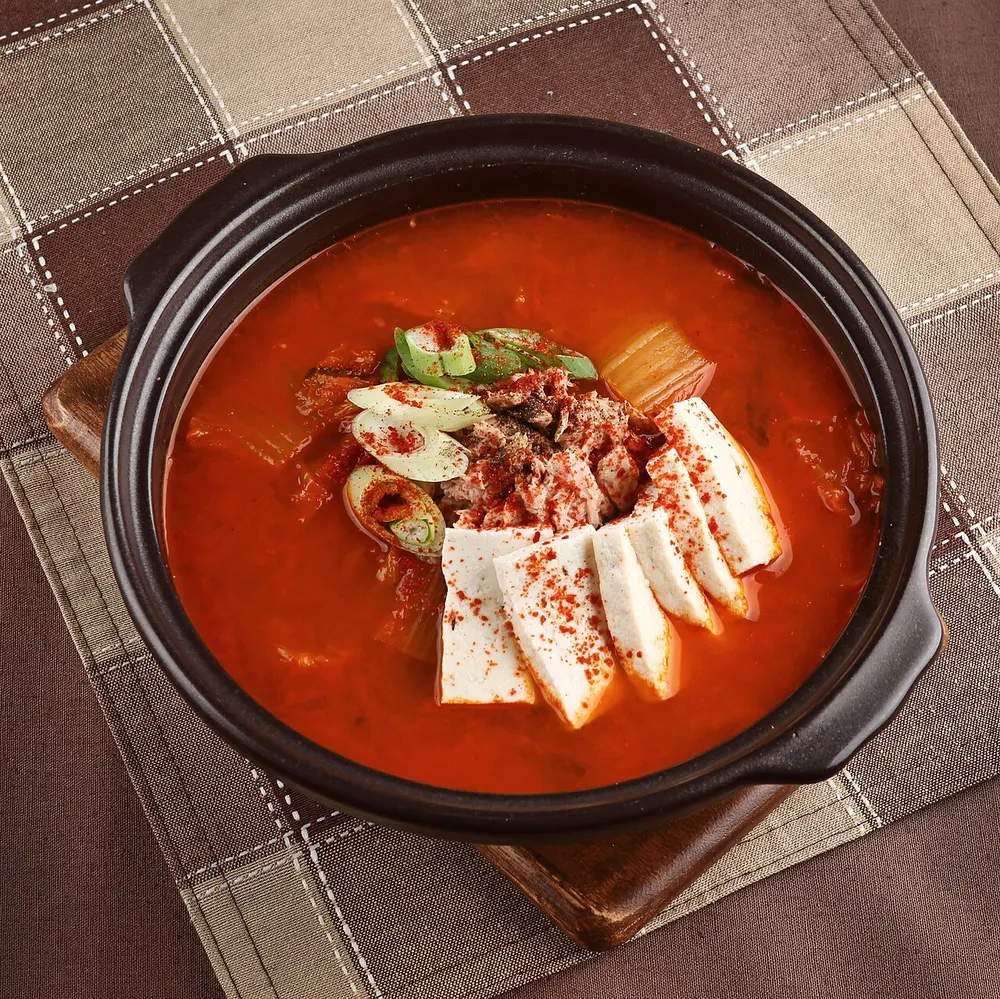
Kimchi Jjigae (Kimchi Stew)
Quelle: Traditionell
30 Min.3420 kcal
Laktosefrei🌶️🌶️
Korean birthday seaweed soup put through a blender and finished with butter and cream — a pack of ready-made miyeok-guk becomes a restaurant velouté, with one seared abalone floated on top.
Quelle
Rezept von 정호영 · 👨🍳 Küchenchef · Jung Ho-young — Japanese-cuisine chef, trained at the Tsuji Culinary Institute, Japan
Namen von Köchinnen, Köchen und Creators erscheinen ausschließlich als Quellenangabe. More Recipes Please ist unabhängig und wird von ihnen weder unterstützt noch gesponsert.
Jung Ho-young (Kitchen Caden) — Published by Jung Ho-young on his own YouTube channel, 정호영의 오늘도 요리 Kitchen Caden, as '오늘부터 최고의 보양식은 이겁니다! 전복미역스프!!!'. The ingredient list and numbered method are printed in the video description, including his aside that only one abalone goes into the soup while the second is seared for the top, and every quantity here is taken from it. The dish is his own fusion rather than a traditional one: Korean miyeok-guk is treated with French soup technique — sweated aromatics, blended smooth, mounted with butter and cream — but finished with sesame oil rather than more butter.
Koch: 정호영
Zubereitung im Video
Clean the abalone: scrub the shells, prise the meat out, and separate the innards from the flesh, keeping both.
💡 Keep the innards — that dark green sac is not waste. It carries most of the abalone's deep sea flavour and it is what will tint this soup and give it its guts. Just work gently: burst it against the shell and you lose it.
Roughly chop the innards and the flesh of one abalone. Leave the second abalone whole — it is for the garnish.
Roughly chop the onion (1/4개) and the garlic (1알).
Film a pan with olive oil — about three turns round the pan — and sweat the onion and garlic over gentle heat for 3–4 minutes, until soft and translucent but not coloured.
💡 Gentle, and no browning. Any caramelisation puts a sweet, roasted note into a soup that is meant to taste of clean sea and seaweed — and once it is there you cannot take it out.
Tip the pack of miyeok-guk into a sieve set over a bowl and let it split into solids and liquid. Keep both.
💡 Separating them is what lets you control the final thickness. Blending the whole pack at once would leave you with a thin, sloshy soup and no way back.
Add the seaweed solids, the chopped innards and the chopped abalone flesh to the pan and fry for 2–3 minutes, until the innards darken and the pan smells strongly of the sea.
Pour in about half of the reserved miyeok-guk liquid and bring it to a simmer for 3–4 minutes.
Blend it completely smooth, then pour it back into the pan.
💡 Blend it longer than feels necessary. Seaweed is fibrous and stringy — a soup that is 95% smooth still reads as gritty on the tongue, and that is the difference between a velouté and blended soup.
Add the milk (6큰술 / 80ml) and the butter (10 g) and let it reduce gently over low heat for a few minutes, stirring, until it coats the back of a spoon.
Stir in the heavy cream (2큰술 / 30ml) last and reduce for just a moment more.
💡 Cream goes in at the end and barely cooks. Boiled hard it splits and you get grey soup with fat beads on it — and around this much salt and seaweed acid, it splits easily.
Taste it now, then add salt only if it needs it.
💡 The miyeok-guk pack is already seasoned and the abalone brings its own sea salt. He puts salt last and calls it optional for exactly this reason.
Sear the reserved whole abalone in a hot pan for about a minute a side, just until the edges firm and curl and it takes a little colour.
Ladle the soup into bowls, slice the seared abalone and lay it on top, and finish with a few drops of sesame oil and a grind of black pepper.
💡 The sesame oil at the very end is the tell that a Korean cook made this. A French velouté would finish with more butter — this one goes home with one nutty, unmistakably Korean note on top of the cream.
Korean
Quelle: Traditionell

Korean
Quelle: Hausmannskost
Korean
Quelle: Hausmannskost
Korean
Quelle: Traditionell
Nachgekocht? Teile ein Foto in der Galerie.
Zeig dein Werk →