Foto folgt
Einsteiger
French
Classic French Omelette
Quelle: Küchenchef
10 Min.1300 kcal
VegetarischGlutenfreiLow Carb+1
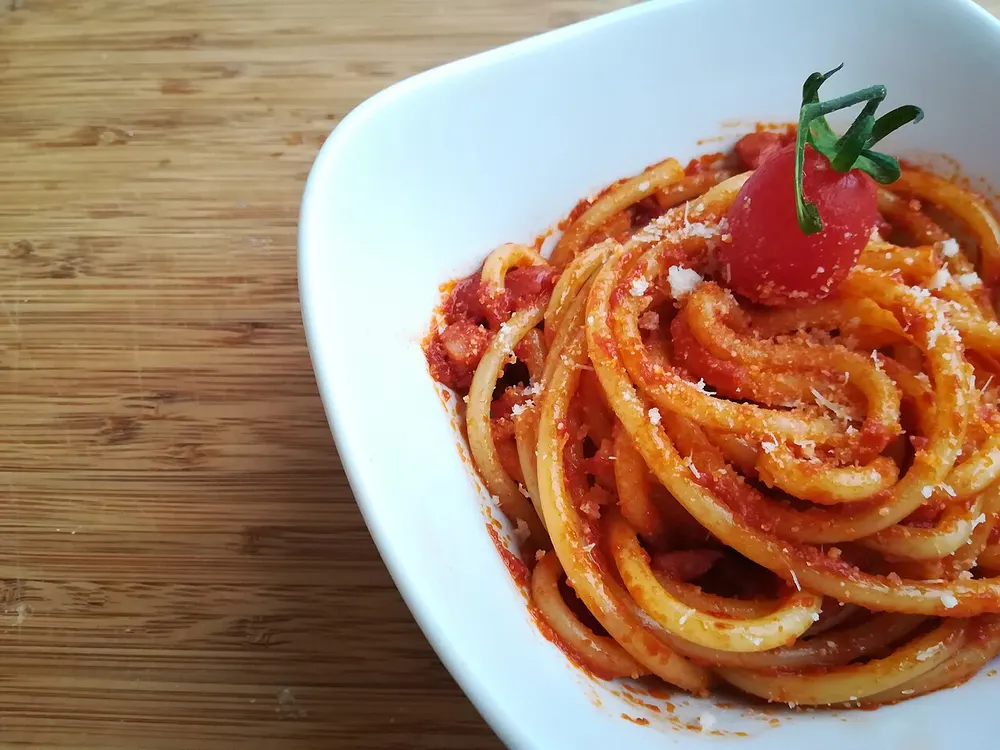
Guanciale crisped until its fat runs clear, a splash of white wine, tomato, chilli and pecorino — and pointedly no garlic and no onion, which is exactly what Amatrice went to the EU to protect.
Quelle
Rezept von Amatrice & Roman home kitchens · 🏠 Hausmannskost · Shepherds' cooking from Amatrice, adopted by Rome
Traditional · Amatrice, Lazio — From Amatrice, a town in the province of Rieti that passed from Abruzzo to Lazio in 1927; it reached Rome with Amatrice innkeepers and shepherds and became a Roman classic despite being born elsewhere. The EU registered 'Amatriciana tradizionale' as a Traditional Speciality Guaranteed in March 2020: guanciale sautéed and deglazed with dry white wine, San Marzano or peeled tomatoes, pecorino, chilli, salt and pepper — with neither garlic nor onion, and no pancetta in place of guanciale.
Zubereitung im Video · 3 Videos
Cut the guanciale into short strips about 1 cm thick — chunky, not thin. Trim off the hard rind and keep it for a soup another day.
💡 Cut thin and it will vanish into crisps; cut chunky and each piece stays meltingly soft inside its crisp shell. That contrast is the dish.
Put the guanciale into a cold, dry pan — no oil at all — and set it over medium-low heat.
💡 Starting cold lets the fat render out slowly instead of searing shut. That rendered fat is the only cooking fat this sauce needs, and it carries all the flavour.
Let it cook 6–8 minutes, stirring now and then, until the fat has run clear into the pan and the lean edges are golden and crisp.
Lift about half the crisp guanciale out with a slotted spoon and set it aside on a plate — that half goes back at the very end.
💡 Everything that simmers in tomato goes soft. Holding half back is how you still have something crunchy on the plate 20 minutes later.
Turn the heat to medium-high and pour in the white wine. Let it hiss and bubble for about 1 minute, scraping the pan, until the sharp alcohol smell has burned off.
Add the crumbled chilli, then the hand-crushed tomatoes, and a small pinch of salt.
Simmer over medium-low for 12–15 minutes, until the sauce darkens from bright red to brick and the guanciale fat rises in orange beads at the edges.
💡 Those orange beads are the sign the fat and tomato have made friends. Before that, the sauce still tastes like two separate things.
Meanwhile boil the bucatini in well-salted water, and drain them 2 minutes before the packet time. Keep a cup of the water.
Tip the bucatini into the sauce and toss over medium heat for 2 minutes, adding splashes of pasta water, until they finish cooking in the sauce and the pan turns glossy.
💡 Bucatini are thick and hold their bite well, so they are forgiving here — but they also spray sauce when you eat them. That is not a flaw; it is the reason Romans wear the sauce on their shirts.
Take the pan off the heat, wait a few seconds, then scatter in most of the grated pecorino and toss until it melts into the sauce.
Grind over black pepper and taste. It will rarely need salt — between the guanciale and the pecorino, the salt is already there.
Serve in warm bowls, topped with the crisp guanciale you set aside and the last of the pecorino.
French
Quelle: Küchenchef
French
Quelle: Traditionell
French
Quelle: Küchenchef
Italian
Quelle: Hausmannskost
Nachgekocht? Teile ein Foto in der Galerie.
Zeig dein Werk →