Новичок
Korean
Kimchi Jjigae (Kimchi Stew)
Источник: Традиционное
30 мин3420 ккал
Без молочного🌶️🌶️
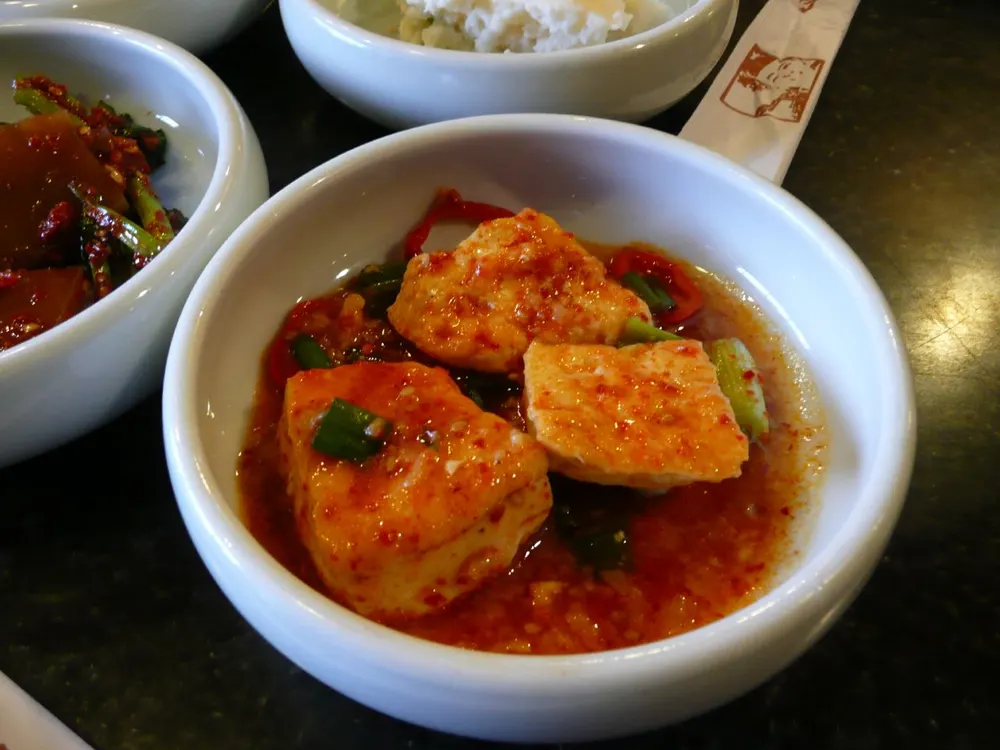
No frying the tofu first, no bowl of pre-mixed sauce. Raw slices are laid flat in a shallow pan, half-drowned in water, and everything else is simply piled on top and reduced down.
Источник
Автор рецепта 백종원 · 👨🍳 Шеф-повар · Paik Jong-won — chef & restaurateur, 백종원의 요리비책
Имена поваров и авторов указаны только как ссылка на источник. More Recipes Please независима, не связана с ними, не одобрена и не спонсируется ими.
Paik Jong-won (요리비책) — Published by Paik Jong-won on his own YouTube channel as '얼큰하고 매콤하게~ 밥도둑 두부조림!' (Hot and spicy dubujorim), where he says a slight kick is the point and that you have succeeded if it makes you want rice. His version takes two shortcuts against the standard recipe: the tofu is never pan-fried — raw slices are laid in a shallow pan and half-covered with water — and no sauce is pre-mixed, with every seasoning simply scattered over the top to dissolve as it reduces. Perilla oil, not sesame, goes in once the sauce is halfway down.
Повар: 백종원
Смотри, как это готовят · 3 видео
Slice the green onion and the Cheongyang chili into thin rounds about 0.3 cm thick.
Halve the tofu block lengthways, then cut it across into slices about 1 cm thick.
💡 1 cm is thin enough for the sauce to reach the middle in the short time this cooks, and thick enough that the slices do not collapse when the pan comes to a boil.
Lay the raw tofu slices out flat across the bottom of a shallow pan, in a single layer, without frying them first.
💡 This is the shortcut that defines his version. Most dubu-jorim recipes pan-fry the tofu golden first, which is the step that costs time, oil and a spattered stove. Here the tofu goes in raw and the braise does all the work.
Pour in the filtered water until the tofu is submerged about halfway — not covered.
💡 Halfway is a braise; covered is a soup. Judge it by eye against your own pan rather than trusting the 180 ml — a wider pan needs more, a narrow one less.
Scatter the saeujeot, coarse gochugaru, jin-ganjang, brown sugar, minced garlic, minced ginger, Cheongyang chili and green onion straight over the top of the tofu.
Do not stir and do not mix a sauce in a separate bowl. Everything simply goes on top.
💡 Stirring is what breaks the tofu. The seasonings dissolve into the water on their own as it heats and the bubbling circulates them — you do not need to help.
Set the pan over medium-high heat and bring it to a boil.
Once it is bubbling, keep it at a steady boil and spoon the sauce over the exposed tops of the tofu every minute or so, so the slices sitting proud of the liquid still take on colour.
💡 He is specific that the tofu should be lightly submerged in the boiling sauce as it reduces. Spooning is how you get there without stirring and without flipping.
Boil until the sauce has reduced by about half — roughly 6–8 minutes. The liquid darkens, thickens slightly and the tofu edges turn from white to red-brown.
Now add the perilla oil and carry on reducing.
💡 Perilla oil, not sesame — and late, not early. Its nutty, grassy aroma is volatile: put it in at the start and you boil the whole point of it away. It also carries the chili colour into a glossy sheen.
Reduce until the sauce is jajak-jajak — just a shallow pool left around the tofu, thick enough to cling rather than run.
💡 Jajak-jajak (자작자작) is the standard Korean doneness cue for a jorim and it is worth learning: not dry, not soupy — enough sauce left to spoon over rice, and no more.
Turn off the heat, lift the slices onto a plate with a spatula rather than tongs, and spoon the remaining sauce over. Serve warm or at room temperature with rice.
Korean
Источник: Традиционное
Korean
Источник: Домашняя кухня
Korean
Источник: Домашняя кухня
Korean
Источник: Традиционное
Приготовил? Поделись фото в галерее.
Покажи своё блюдо →