Mudah
Korean
Kimchi Jjigae (Kimchi Stew)
Sumber: Tradisional
30 min3420 kcal
Bebas tenusu🌶️🌶️
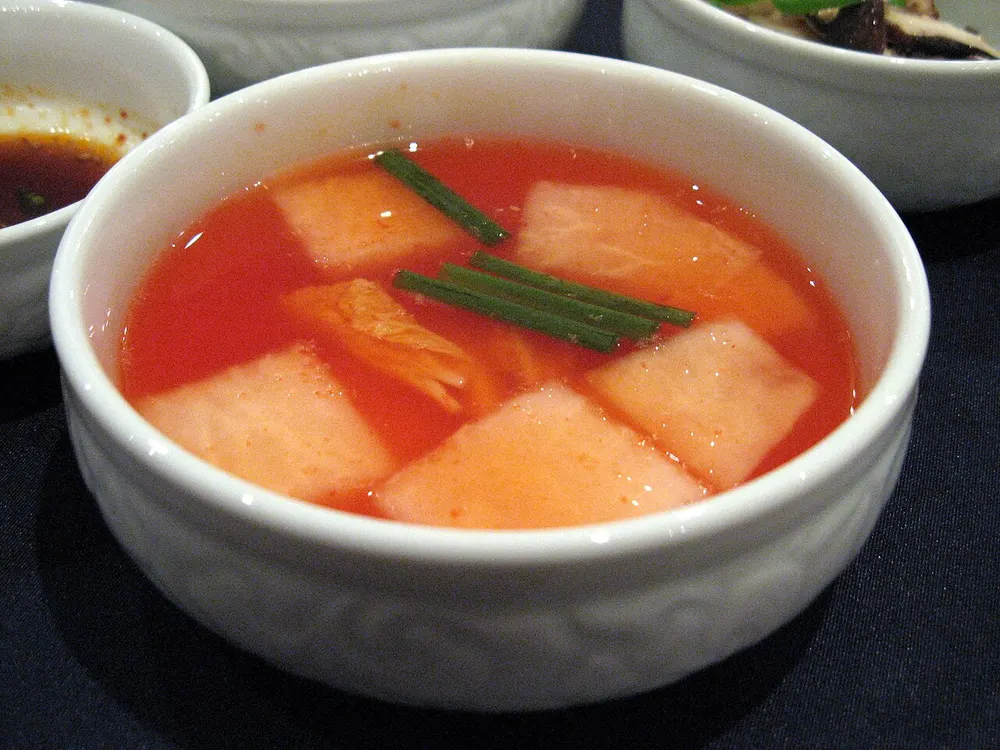
A water kimchi with no grit in it: the chili powder is pushed through a sieve into 2 litres of water so only its colour and flavour go in, and the broth is thickened with a paste of glutinous rice AND buckwheat flour, then poured over squares of spring cabbage and radish.
Sumber
Resipi oleh 강순의 · 👨🍳 Chef · Kang Soon-ui — Korean kimchi cook; MBN's Altoran credits her on air as a kimchi 명인 (master), and she runs the YouTube channel 강순의 나주종가
Nama tukang masak dan pencipta kandungan dipaparkan sebagai kredit sumber sahaja. More Recipes Please bebas dan tidak bergabung, tidak disokong, serta tidak ditaja oleh mereka.
MBN Altoran (알토란) — cook's own published recipe — Published by MBN on 알토란's own channel (알토란 - 집밥 레시피, @Recipe_MBN); the description opens '알토란 425회 강순의 레시피 MBN 230219' and prints her ingredient list, her five numbered steps, and — unusually — the recipes for her kelp stock and her rice paste inside the list itself, so this recipe needs no outside source at all. Broadcaster-published text, not a viewer's write-up. Three things mark it as hers: the chili powder is sieved into 2 L of water so nothing gritty reaches the jar; the paste is glutinous rice AND buckwheat, not rice alone; and stevia stands in for sugar. Two gaps we flag rather than fill: '무 반 개' and '쪽파 반 줌' are given without weights, and the 2 L for the chili water appears only in her method, not in her ingredient list.
Tukang masak: 강순의
Tonton cara membuatnya
Make the stock first: boil 50 g of kelp and 10 dried shiitake in 2 litres of water for 15 minutes, then strain it and let it cool. You need 1½ cups; the rest keeps.
💡 It must go in COLD. Warm stock in a water kimchi starts the ferment before the seasoning is even balanced, and warm brine turns cabbage soft and sour fast.
Cut the radish and the bomdong into 2 cm squares — 나박나박, flat and squarish, which is what gives this kimchi its name.
Make the pulguk: whisk 1 tbsp glutinous rice flour and 1 tbsp buckwheat flour into 1½ cups of water, then heat it gently, stirring, until it thickens to a thin, pourable paste. Cool it completely.
💡 Buckwheat alongside the rice is her signature and it is not decorative — buckwheat gives a lighter, cleaner body than rice alone, so the broth is drinkable rather than gluey. Stir constantly or it catches on the base.
Put ½ cup of chili powder into a sieve set over 2 litres of water and work it through with a spoon, so the colour and flavour wash out and the coarse grounds stay in the sieve. You now have 고춧물, chili water.
💡 This is the step that separates a master's water kimchi from a home one. Chili powder tipped straight in never dissolves — it floats, sinks and gets stuck between your teeth. The sieve buys you a clear red broth for two minutes of work.
Into the chili water go the fish sauce, 1½ cups of the cooled pulguk, the sliced ginger, the minced garlic, 1½ cups of the cooled stock and the stevia. Stir it all together.
Now season with the coarse salt — 1½ tbsp is her figure, but taste as you go.
💡 Salt LAST, after the fish sauce and stock are already in — both bring their own salt, and their strength varies by brand. A water kimchi broth should taste very slightly saltier than you want it, because the vegetables will draw some out overnight.
Put the cut radish and bomdong into your container and pour the broth over them.
Scatter in the chives cut to 3 cm and the diagonally sliced green and red chilies. That is it — the kimchi is made.
💡 Chives and chilies go in last and raw. They are the top notes; simmer or bruise them and the broth turns muddy green instead of staying clean and pink.
Cover it and leave it to ripen 1–2 days — her figure — at room temperature.
💡 Two days in a warm kitchen is not the same as two days in a cold one. Watch it, not the clock: tiny bubbles rising when you tap the container mean it is working.
Taste it. When the broth has turned faintly tart and fizzes a little on the tongue, move it to the fridge.
💡 That tingle is the finish line. Leave it out past it and the ferment runs away — the bomdong goes limp and the broth gets sour rather than refreshing.
Serve it cold in small bowls, broth and all — it is drunk as much as eaten, alongside rich or fried food.
Korean
Sumber: Tradisional
Korean
Sumber: Masakan rumah
Korean
Sumber: Masakan rumah
Korean
Sumber: Tradisional
Sudah cuba? Kongsi gambar di Pameran.
Kongsi hasil anda →