Mudah
Korean
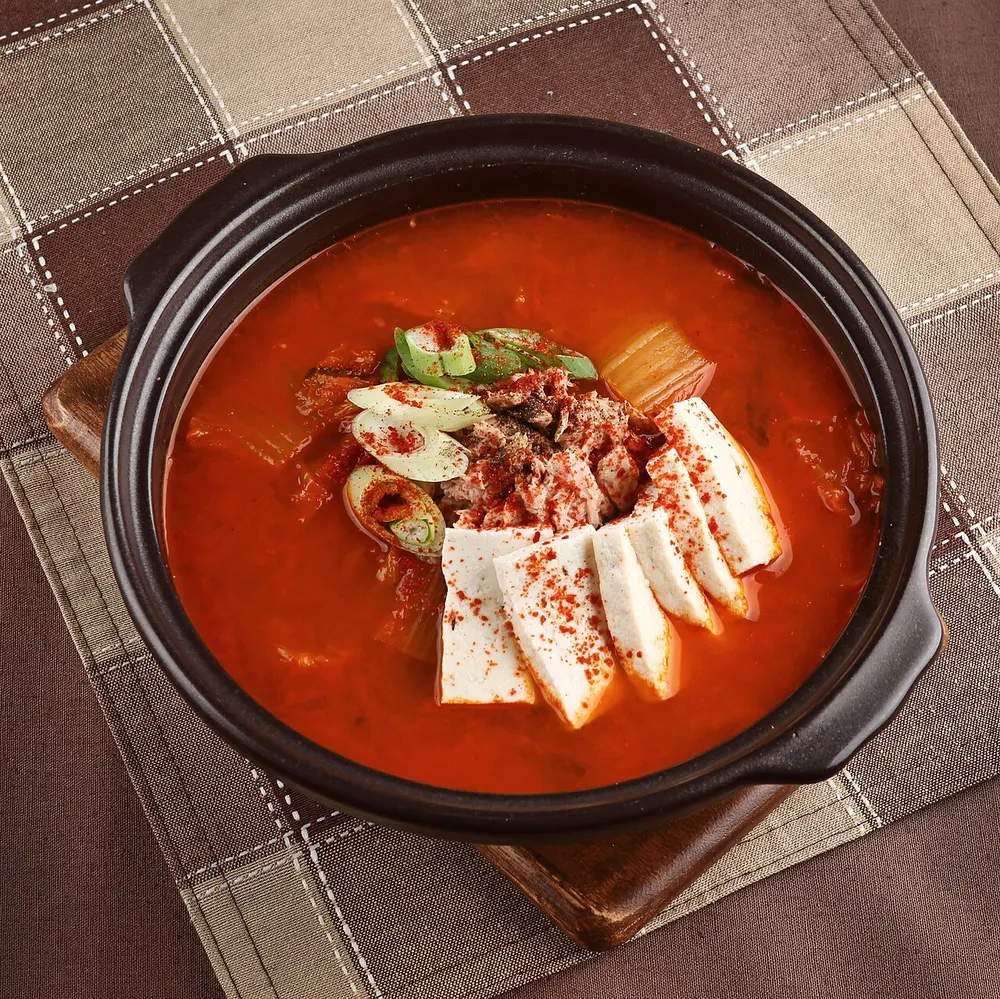
Kimchi Jjigae (Kimchi Stew)
Sumber: Tradisional
30 min3420 kcal
Bebas tenusu🌶️🌶️
Fifteen yolks, separated by hand and lowered into a katsuobushi-infused soy brine, then covered with cling film pressed to the surface so they stay submerged. Five hours later they cut like soft cheese and turn a bowl of rice into a meal.
Sumber
Resipi oleh 정호영 · 👨🍳 Chef · Jeong Ho-yeong — chef (셰프); Altoran's own video titles call him '정호영 셰프' and '스타 셰프 정호영', and his segments are Japanese-style dishes
Nama tukang masak dan pencipta kandungan dipaparkan sebagai kredit sumber sahaja. More Recipes Please bebas dan tidak bergabung, tidak disokong, serta tidak ditaja oleh mereka.
MBN Altoran (알토란) — Published by MBN on Altoran's own channel (알토란 - 집밥 레시피, @Recipe_MBN); the description carries the full ingredient list and method and credits it as 'Altoran episode 176 … #정호영', with its own chapter marker at 02:35 for the dalgyaljang. The channel's own titles elsewhere call him '정호영 셰프' and 'star chef'. Broadcaster-published text, not a viewer's write-up. What marks his version out is Japanese technique applied to a Korean jang: the brine is steeped with 10 g of katsuobushi OFF the heat like a dashi and strained, it is deliberately dilute at roughly 1 part soy to 2.7 parts water, the yolks are separated by hand rather than through the shell, and cling film is pressed onto the surface to hold them under for the full 5 hours. Note the video also contains a separate 달걀찜 recipe, which is not the dish reproduced here. His text gives no curing temperature; the fridge is this book's recommendation, not his.
Tukang masak: 정호영
Tonton cara membuatnya · 3 video
Put 400 ml water, 150 ml jin-ganjang, 2 tbsp matsul, 2 tbsp cheongju and 2 tbsp sugar in a pan.
Boil on high for 4 minutes, until the sugar has completely dissolved — his figure.
💡 The boil is not just for dissolving sugar — it burns the alcohol off the matsul and cheongju. Skip it and the finished yolks carry a raw, spirituous edge that five hours will not remove.
Turn the heat OFF, add the 10 g of katsuobushi, and let it steep 10 minutes — his figure.
💡 Off the heat, always. Katsuobushi boiled rather than steeped goes sour and fishy instead of savoury — the same rule that governs a Japanese dashi, which is exactly where this move comes from.
Strain the katsuobushi out through a sieve and discard it.
Let the brine cool to room temperature — he calls for 한 김 식히기.
💡 Do not rush this. A warm brine will begin to cook the yolks the instant they go in, and you will find a skin has set on them by the time they are submerged.
Pour the cooled brine into an airtight container, wide enough that the yolks can sit in a single layer.
Separate the yolks his way: crack an egg into your cupped fingers and shake gently so the white runs through the gaps and the yolk stays sitting on your hand.
💡 Hands beat shell-to-shell every time here — a shell edge is sharp and it is what usually cuts the yolk. Work over a second bowl so a burst yolk costs you one egg, not the whole batch.
Lower each separated yolk into the brine, keeping them in one layer.
Cut a sheet of cling film to the size of the container.
Lay the film directly onto the surface so it touches the brine and the yolks, then press out any air pockets.
💡 Yolks float, and a floating yolk cures only on its underside and dries out on top. The film pressed onto the surface is what holds them under — it is doing a job, not covering the dish.
Cure 5 hours — his figure. His text does not say at what temperature, so the fridge is what we suggest: these are raw yolks, and 5 hours at room temperature is not a risk worth taking.
💡 The clock is not a suggestion. Under 5 hours the centre is still liquid; well over, the yolk turns dense and salty. Five is where it is spoonable at the edge and gelled through the middle.
Peel the film off and lift the yolks out with a spoon. Serve one on hot rice and break it with the spoon at the table.
Korean
Sumber: Tradisional
Korean
Sumber: Masakan rumah
Korean
Sumber: Masakan rumah
Korean
Sumber: Tradisional
Sudah cuba? Kongsi gambar di Pameran.
Kongsi hasil anda →