Principiante
Korean
Kimchi Jjigae (Kimchi Stew)
Fonte: Tradizionale
30 min3420 kcal
Senza latticini🌶️🌶️
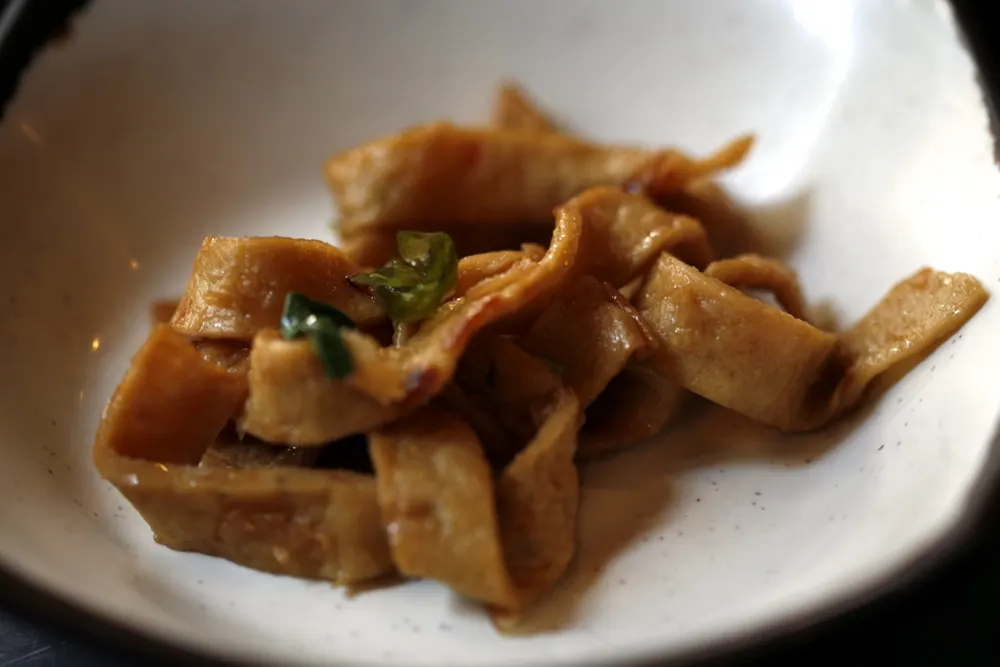
The banchan with no technique at all: fish cakes, potato, onion, scallion, chili, oil and garlic all go into a cold pan together, then soy and sugar braise down to a glaze.
Fonte
Ricetta di 백종원 · 👨🍳 Chef · Paik Jong-won — chef & restaurateur, 백종원의 요리비책
I nomi di cuochi e creator compaiono solo come indicazione della fonte. More Recipes Please è indipendente e non è affiliata, approvata né sponsorizzata da loro.
Paik Jong-won (요리비책) — Published by Paik Jong-won on his own YouTube channel as '다 때려넣으면 끝~ 제일 쉬운 어묵볶음'; the description heads the recipe 어묵감자볶음 and carries his full gram/ml table, his nine-step method and an official English translation. The distinctive thing is what he removes: there is no sequencing at all. Fish cakes, potato, onion, scallion, chili, oil and garlic go into a cold pan together and the heat is turned on under them, then soy and sugar braise the potato through and reduce to a glaze.
Cuoco: 백종원
Watch it being made
Halve the square fish cake sheets lengthways, then slice them into 2 cm strips. Slice the tube fish cakes about 1 cm thick on the diagonal.
Halve the onion crossways and cut it into chunks about 2 cm thick. Slice the green onion and Cheongyang chilies into thin 0.3 cm rounds.
Quarter the potato lengthways into a cross shape, then slice each quarter into thin 0.3 cm pieces.
💡 Cut the potato genuinely thin. It is the slowest thing in the pan and there is no separate cooking time for it — at 0.3 cm it finishes in the same few minutes as the fish cake. Thick chunks stay raw and hard in the middle.
Put the fish cakes, onion, green onion, Cheongyang chili, potato, cooking oil and minced garlic into a deep frying pan — all at once, into a cold pan — and set it over high heat.
💡 This is the whole idea of the recipe, and it goes against everything else he teaches: no preheating, no oil first, no order. There is nothing here that needs browning, so there is nothing to gain from staging it.
Wait for the pan to start sizzling, then stir-fry 2–3 minutes until everything is mixed through and the fish cake has softened and the onion turned glassy at the edges.
Pour in the water, the jin-ganjang and the brown sugar, and let it come up to a boil.
Braise it down over medium-high heat for about 5–7 minutes, until the potato is cooked through — test it with a chopstick, which should slide in with no resistance.
💡 He gives no time here, and adds his own note that the water should be adjusted for your fish cake and your heat — 5–7 minutes is our figure. Judge by the potato, not the clock: if the liquid has gone but the potato is still firm, add a splash of water and keep going.
When the seasoning has soaked into the fish cake and the pieces have taken on an even brown colour, add the fine gochugaru and stir it through.
Keep cooking until the liquid has reduced away completely and the fish cake turns glossy — the pan should look shiny and almost dry, not soupy.
💡 'Reduced away and glossy' is his finish line. Stop while there is still sauce in the pan and the banchan will go watery in the fridge overnight — the shine comes from the last of the soy and sugar clinging to the fish cake.
Turn off the heat, add the sesame oil, and stir once to coat.
💡 Sesame oil at the end, off the heat. Its aroma is volatile — cook it and it simply evaporates, and you have used two spoons of an expensive oil for nothing.
Scatter over the whole sesame seeds, turn it onto a plate, and sprinkle a few more seeds on top.
Serve warm as a banchan with rice, or eat it hot straight away as a dish in its own right.
Korean
Fonte: Tradizionale
Korean
Fonte: Cucina casalinga
Korean
Fonte: Cucina casalinga
Korean
Fonte: Tradizionale
L'hai preparato? Condividi una foto in Vetrina.
Condividi la tua creazione →