Foto segera hadir
Pemula
American
Fluffy Buttermilk Pancakes
Sumber: Masakan rumahan
25 mnt4350 kkal
Vegetarian
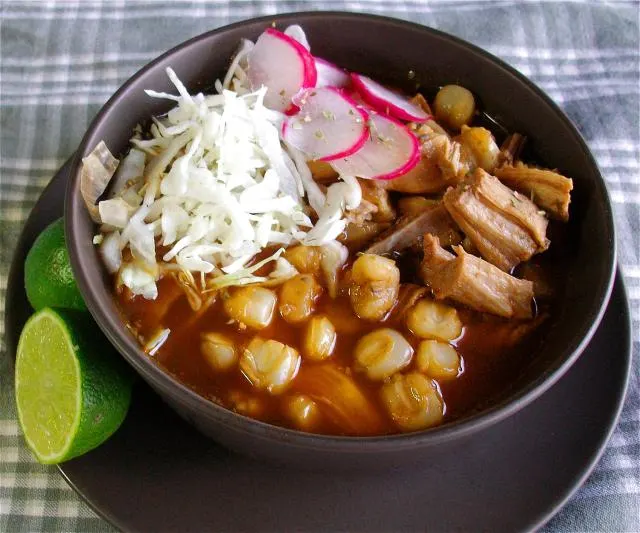
A pre-Columbian hominy stew that survives as Mexico's great party food: pork simmered with big puffed corn kernels in a red guajillo broth, then buried under raw cabbage, radish, onion, oregano and lime at the table.
Sumber
Resep oleh Mexican home kitchens · 🏺 Tradisional
Mexican traditional / pre-Columbian — A traditional Mexican soup or stew made from hominy with meat, garnished with shredded lettuce or cabbage, chili, onion, garlic, radish, avocado, salsa or lime. Known in Mesoamerica since the pre-Columbian era, it is eaten both as an everyday meal and as a festive dish.
Watch it being made · 3 videos
Put the pork and bones in a large pot with 3 L of cold water, half the onion in one chunk, the garlic and the bay leaves. Bring slowly to a simmer.
💡 Start in cold water, not boiling. Cold water draws the proteins and collagen out slowly into the broth; dropping meat into boiling water seals the outside and you get a thinner stock.
As it comes up to heat, skim off the grey foam that gathers on the surface — keep at it for the first 15 minutes until the foam stops forming.
💡 That foam is coagulated protein and it tastes muddy. Skim it now and the finished broth will be clear and clean; leave it and it breaks up into the pot and greys everything.
Simmer gently, partly covered, for 90 minutes, until the pork gives way easily to a fork but still holds together.
Meanwhile, stem and seed the guajillo and ancho chilies, and toast them in a dry pan over medium heat for 20–30 seconds a side, until they smell nutty and flex slightly.
Cover the toasted chilies with 400 ml of hot broth from the pot and soak for 20 minutes, until completely soft and floppy.
💡 Soaking in broth rather than water means nothing you extract from the chilies gets thrown away — it all goes back in the pot.
Blend the soaked chilies with their soaking broth for a full 3 minutes, until absolutely smooth, then pour the purée through a fine sieve into a bowl. Press the solids hard and discard the skins.
💡 Never skip the sieve. Guajillo skins are tough and stay as gritty flecks no matter how powerful your blender, and pozole broth is supposed to be silky.
Lift the pork out of the broth. Discard the bones, the boiled onion and the bay leaves, and strain the broth if it looks cloudy.
Pour the chili purée into the broth and bring it back to a simmer. It will turn deep brick-red immediately.
💡 The colour looks alarming at first and settles as it cooks. This is 'rojo' pozole — there is also a green version with tomatillos and a white one with no chili purée at all.
Return the pork to the pot with the drained hominy and half the oregano, crushing the oregano between your palms as it goes in.
Simmer uncovered on low for 40 minutes, until the hominy kernels have burst open into flower shapes and gone tender but still chewy.
💡 Those burst kernels are why the dish exists — the corn is nixtamalised, which is what lets it flower like that. Tinned hominy is already cooked, so this stage is really about letting it drink the red broth.
Taste the broth and salt it properly. It should taste slightly stronger than you want, because everything at the table will dilute it.
Set out the shredded cabbage, sliced radish, diced raw onion, the rest of the oregano, lime wedges and tostadas in separate bowls.
Ladle the pozole into deep bowls and let everyone dress their own — the garnishes go on at the table, not in the kitchen.
💡 This is not presentation — it is how the dish works. The raw cabbage and radish must stay crunchy and cold against the hot broth, and they wilt within a minute of hitting it.
American
Sumber: Masakan rumahan

American
Sumber: Masakan rumahan
Modern
Sumber: Tradisional

Modern / viral
Sumber: Influencer
Sudah coba bikin? Bagikan fotonya di Etalase.
Bagikan hasil masakanmu →