Foto segera hadir
Pemula
French
Classic French Omelette
Sumber: Chef
10 mnt1300 kkal
VegetarianBebas glutenRendah karbo+1
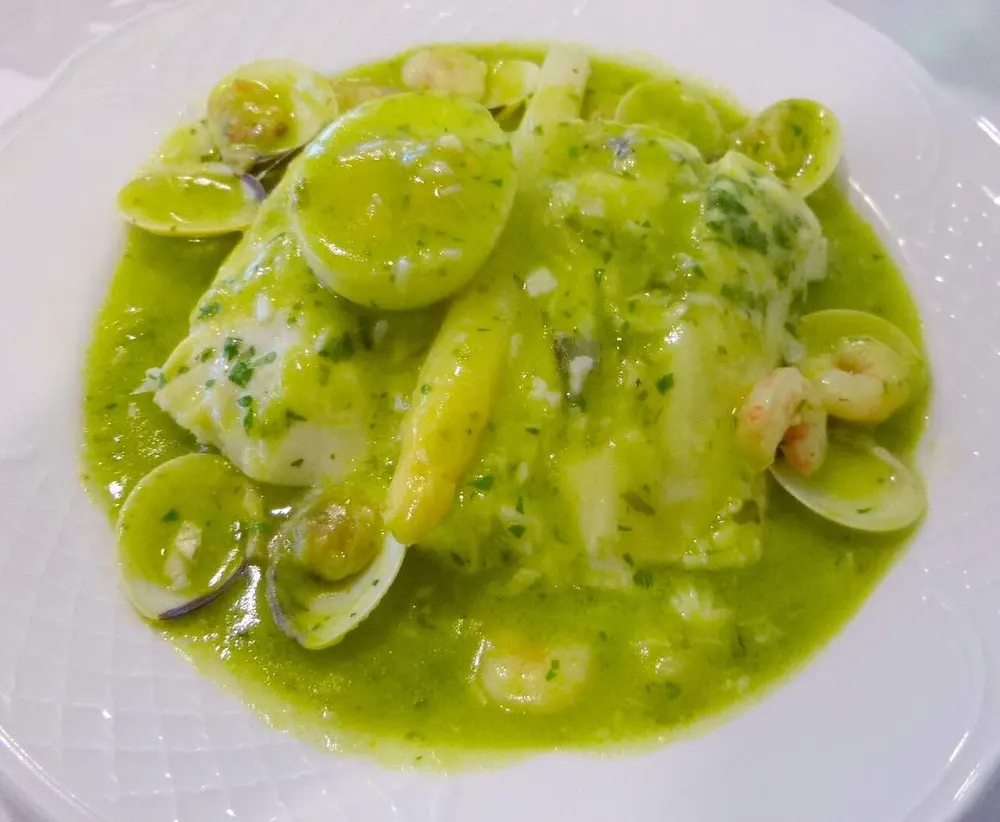
The Basque country's most famous sauce, and it has no cream in it at all — garlic, onion, a spoon of flour, wine and fish stock, thickened by swirling the pan until the fish's own gelatine turns it silky. Twenty-five minutes, one pan.
Sumber
Resep oleh Joseba Arguiñano · ⭐ Selebriti · Basque cook and television presenter, son of Karlos Arguiñano; he cooks on the family's daily programme and publishes on the same official site
Nama juru masak dan kreator hanya dicantumkan sebagai kredit sumber. More Recipes Please independen dan tidak berafiliasi, tidak didukung, serta tidak disponsori oleh mereka.
Joseba Arguiñano · Hogarmania (official) — Published on the Arguiñano family's official site hogarmania.com. This page is credited to JOSEBA Arguiñano — Karlos's son — not to Karlos, and is stated as 2 raciones. Quantities are his; the method text was rewritten here for beginners.
Koki: Joseba Arguiñano
Watch it being made
Put the clams in a bowl of cold salted water for 30 minutes so they spit out their sand. Change the water once if it looks cloudy.
💡 Nothing else in this dish can be rescued from grit. Thirty minutes of soaking is the difference between a lovely sauce and one that crunches.
Tap any clam that is sitting open. If it closes, it is alive and fine; if it stays open, throw it away.
Pat the hake fillets dry with kitchen paper and season them lightly with salt on both sides. Leave them out while you start the sauce.
Chop the garlic clove finely, and make sure the half onion is chopped fine too.
💡 Chop both smaller than feels necessary. This sauce is never blended, so whatever size you cut is the size you will be eating.
Warm the 30 ml of olive oil in a wide, shallow pan — ideally an earthenware cazuela — over medium heat.
💡 Wide and shallow matters: the four fillets must sit in one layer with sauce around them, not piled up in a deep pot.
Add the garlic and cook it for about a minute, until the edges are just starting to turn gold and the kitchen smells of it.
💡 Just starting — not golden all over. Garlic goes from fragrant to bitter in about fifteen seconds at this heat.
Stir in the chopped onion, turn the heat down to low and let it soften for 6–8 minutes, until it is translucent and floppy with no colour on it at all.
💡 Green sauce should stay pale. Brown the onion and you get a tasty sauce, but a beige one — and it will not be salsa verde any more.
Scatter in the 10 g of flour and stir it around for a full minute so it cooks into the oil.
💡 Ten grams is barely a tablespoon and that is deliberate. This sauce is not meant to be a gravy — the flour only gives the emulsion something to hang on to.
Pour in the 50 ml of white wine and let it bubble for about a minute, until the sharp alcohol smell has burned off.
Add the 100 ml of fish stock. Instead of stirring, take the pan by the handles and swirl it in slow circles until the sauce looks smooth.
💡 That swirling motion — Basque cooks call it the vaivén — is the entire technique of salsa verde. Do not reach for a whisk; you want the sauce moving as one body.
Slide the hake fillets into the pan, skin side down, in a single layer. Cook for about 3 minutes over gentle heat — the surface should barely tremble.
💡 Keep it well below a boil. Hake is delicate; a hard bubble breaks the flakes apart and splits the sauce at the same time.
Turn the fillets over carefully with a fish slice. Add the clams, the asparagus tips and a good handful of chopped parsley.
💡 One turn, and support the fillet along its whole length. Hake will fall into pieces if you try to flip it with a fork at one end.
Cover the pan and cook a few minutes more, until every clam has opened and the fish has turned from glassy to opaque white.
💡 The clams are the timer here — they open in roughly 3 minutes and the fish is done at about the same moment. Any clam still shut at the end goes in the bin, not on the plate.
Take the pan off the heat and swirl it again in slow circles for 20–30 seconds. You will see the sauce go from watery to glossy and slightly thick as it emulsifies.
💡 This is where the sauce is actually made. Gelatine from the hake skin plus the clam juices plus the olive oil come together only if you keep the pan moving off the heat.
Divide the fish, clams and asparagus between two warm plates, spoon the green sauce over the top, and eat it straight away with bread.
French
Sumber: Chef
French
Sumber: Tradisional
French
Sumber: Chef
Italian
Sumber: Masakan rumahan
Sudah coba bikin? Bagikan fotonya di Etalase.
Bagikan hasil masakanmu →