Baguhan
Korean
Kimchi Jjigae (Kimchi Stew)
Pinagmulan: Traditional
30 min3420 kcal
Walang gatas🌶️🌶️
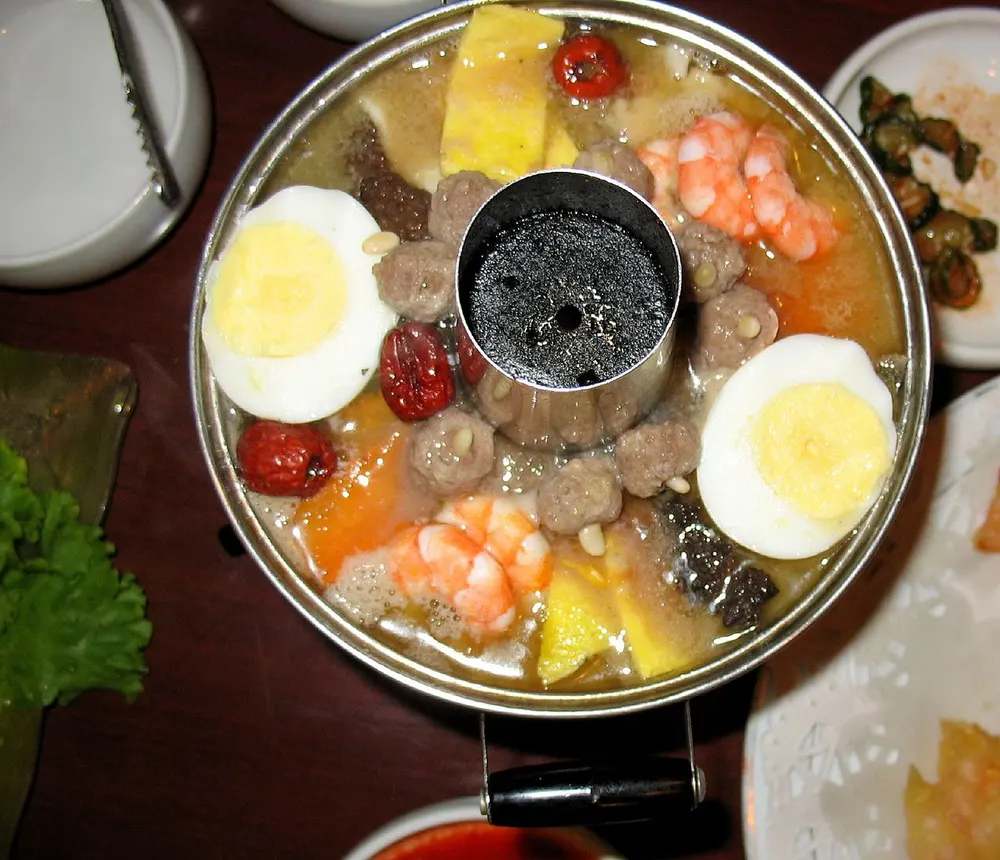
The showpiece of the Joseon royal table, taught by the woman who holds the state heritage licence for it: a brass pot with a charcoal chimney, packed in rings with sliced brisket, tripe, meatballs, fish fritters and five-colour garnish, then flooded with a broth reduced by half.
Pinagmulan
Recipe ni 한복려 · 👨🍳 Chef · Han Bok-ryeo — researcher of Joseon royal court cuisine; holder of National Intangible Cultural Heritage no. 38 (Joseon royal court cuisine) since 2007; director of the Institute of Korean Royal Cuisine
Ang pangalan ng mga nagluluto at creator ay nakalagay bilang pagkilala sa pinagmulan lamang. Malaya ang More Recipes Please at walang kaugnayan, pag-endorso o sponsorship mula sa kanila.
MBN Altoran (알토란) — cook's own published recipe — Published by MBN on 알토란's own channel (알토란 - 집밥 레시피, @Recipe_MBN), whose description opens '알토란 419회 한복려 레시피 MBN 230108' and then prints her full ingredient list in grams and her numbered method — broadcaster-published text, not a viewer's write-up. (One caveat we are naming rather than hiding: that description's ingredient heading reads '[죽순채 재료]', which is an MBN copy-paste slip — the list under it is unmistakably the sinseollo one, and the method below is headed '[신선로 만드는 법]'.) What marks her version is the broth: shank and tripe boiled together with radish and carrot until it has reduced by half, then strained through cloth — no shortcut stock anywhere.
Nagluto: 한복려
Panoorin habang niluluto
Soak the beef shank in cold water to draw out the blood, changing the water when it clouds. Scrub the tripe hard with coarse salt, then rinse it clean.
💡 한복려's text says 'blood-drawn shank' and 'tripe washed with salt' but never times either. Our guide: 30–60 minutes for the shank, two or three changes of water. Skip it and the broth turns grey and smells of iron — the whole pot is built on this broth being clear.
Bring a pot of water to a rolling boil and put in the whole shank and the tripe. Add the green onion roots, garlic and peppercorns, and keep it at a steady simmer.
💡 Meat into boiling — not cold — water. It seizes the surface so the juices stay in the meat instead of leaching into the broth, which is what you want when the meat is going to be eaten sliced.
Add the radish and the carrot and let it all simmer until the broth has reduced by half — 한복려's own marker. Expect 1.5–2 hours over a low, barely-trembling flame.
💡 'Reduced by half' is the only doneness cue she gives, and it is a concentration target, not a clock. Boil it hard to get there faster and you will cloud the broth; a royal pot wants it clear enough to see the garnish through.
Strain the finished broth through a cloth (면보) into a clean bowl and set it aside. Lift out the shank and the tripe.
Slice the boiled shank and tripe thin. Slice the boiled radish and carrot, the rehydrated shiitake and the RAW top round thin as well — everything roughly the same size, so the rings sit flat.
💡 Chilling the boiled meat for 20 minutes first makes it far easier to slice thinly. Beginners nearly always cut sinseollo pieces too thick, and thick pieces will not cook through in the pot's short boil.
Stir the guk-ganjang, minced garlic and pepper together (with the bracketed green onion and sesame oil if you are using them). Toss half of it through the boiled meat and half through the raw top round, in separate bowls.
Meatballs: knead the minced top round and the mashed tofu with the salt, minced onion, garlic, sesame seeds and sesame oil until the mix turns sticky and holds its shape.
💡 Keep kneading past the point where it looks mixed. The stickiness is the protein binding, and it is the only thing stopping the balls from falling apart in the broth.
Spread 1 tbsp of flour on a plate, pinch off same-size pieces of the mix and roll them into balls in the flour. Dip them in beaten egg (pass the egg through a sieve first), then fry them gently in a lightly oiled pan until set and lightly golden, 3–4 minutes over medium-low.
💡 Sieving the egg removes the chalazae, so the coating goes on as a smooth, even yellow film instead of a streaky one. That is a court-kitchen habit and it is the whole reason her method mentions the sieve.
Fish fritters: pat the fish dry, season it with salt and white pepper, dust it thinly with flour, dip it in beaten egg and fry it in a hot oiled pan until golden, about 1 minute a side.
💡 White pepper, not black — the court palette avoids dark specks on pale food. Dry fish is non-negotiable: wet fish sheds its flour and the egg slides straight off.
Minari skewers (minari-chodae): lay the minari flat, pin it top and bottom with bamboo skewers so it holds as a mat, coat it in flour then egg, and fry it in the same pan until just set and still green.
Cut the fish fritters and the minari mat into strips 3 cm wide. Keep the trimmings — they are not waste.
💡 3 cm is the height of the pot's ring, so every piece stands upright and shows its edge. The trimmings go in the base as a bed, which is exactly what her method does with them.
Load the pot: trimmed offcuts and leftover vegetable scraps on the bottom, then the boiled radish and carrot, then the raw seasoned beef, then the boiled meat, then the vegetables, then the meatballs, and finally the walnuts, ginkgo nuts and pine nuts on top.
💡 한복려's list includes seogi mushrooms and half a red chili as five-colour garnish but her published method never says how to cut them; the standard court treatment — ours, not hers — is fine 3 cm shreds tucked in with the vegetables, along with yellow and white egg ribbons from the remaining eggs.
Season the reserved broth with 1 tbsp of soy sauce, taste it, then pour it slowly down the inside wall of the pot, turning as you go, until it comes up under the top layer.
💡 Pour down the wall, never over the top. A stream landing on the middle will capsize the rings you just spent an hour building.
Light charcoal in the central chimney and carry the pot to the table still boiling. 한복려 rests a rice bowl upside-down on the lid to hold the heat in.
💡 No brass sinseollo pot? Any lidded casserole on a portable burner works — you lose the theatre and the chimney's even heat, but not the food. Never light charcoal indoors without ventilation.
Eat straight from the pot as it simmers, lifting a little of each ring into your bowl and ladling broth over it. Top the pot up with any leftover broth as it goes down.
Korean
Pinagmulan: Traditional
Korean
Pinagmulan: Home cook
Korean
Pinagmulan: Home cook
Korean
Pinagmulan: Traditional
Niluto mo? Magbahagi ng larawan sa Showcase.
Ibahagi ang niluto mo →