Baguhan
Korean
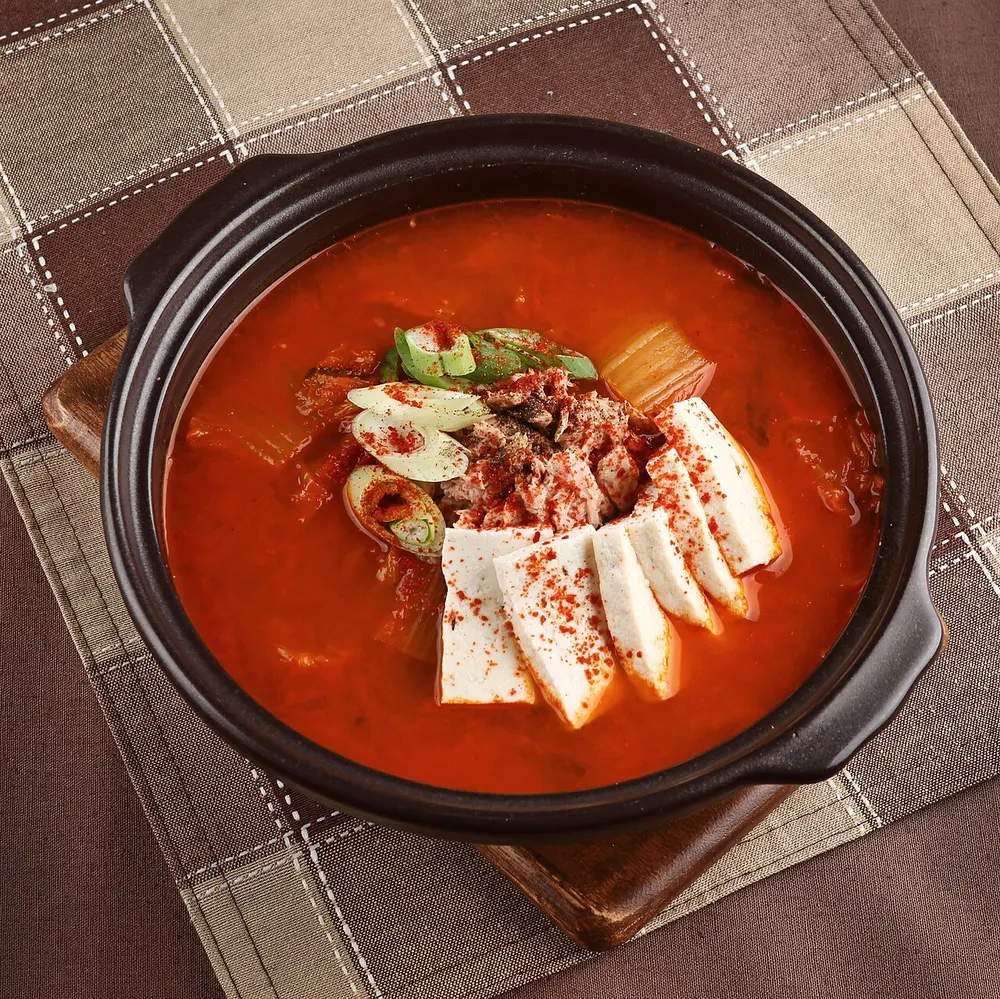
Kimchi Jjigae (Kimchi Stew)
Pinagmulan: Traditional
30 min3420 kcal
Walang gatas🌶️🌶️
Cabbage leaves are dusted with starch, rolled around perilla in a sushi mat, tied and steamed for 20 minutes, then chilled until they slice like gimbap. Served cold against hot, crisp-seared brisket and a chunky doenjang dressing built on shiitake soaking water.
Pinagmulan
Recipe ni 유현수 · 👨🍳 Chef · Yu Hyun-su — chef (셰프); Altoran's own video titles consistently call him '유현수 셰프'
Ang pangalan ng mga nagluluto at creator ay nakalagay bilang pagkilala sa pinagmulan lamang. Malaya ang More Recipes Please at walang kaugnayan, pag-endorso o sponsorship mula sa kanila.
MBN Altoran (알토란) — Published by MBN on Altoran's own channel (알토란 - 집밥 레시피, @Recipe_MBN), whose description carries the full ingredient table and a 12-step method and heads it 'Altoran episode 362, Yu Hyun-su's recipe'. Broadcaster-published text, not a viewer's write-up. What marks his version out: the cabbage is starched and rolled in a bamboo mat like gimbap and steamed 20 minutes, then chilled hard so it slices clean and is served COLD against hot crisp brisket; the doenjang dressing is built on the mushrooms' own soaking water and taken off the heat the instant the paste goes in; and the cabbage root block everyone else discards is minced into that dressing.
Nagluto: 유현수
Panoorin habang niluluto
Cut the root end off the baby cabbage (630 g) and peel the leaves away one at a time. Keep the root block and the small inner leaves — both are used later.
💡 The root block looks like waste and is not: it gets minced into the doenjang dressing in step 8. Throwing it away costs you the sweetest part of the cabbage.
Press the thick white stem of each leaf flat with the heel of your hand, then lay the leaves out on a tray in a single layer, not overlapping.
💡 Flattening the stem is what lets a leaf bend into a tight roll instead of cracking. An unpressed stem springs back and leaves a hollow channel down the middle of the roll.
Dust starch evenly over the leaves — his list says only 'as needed', so aim for a light, even veil rather than a thick coat.
Lay 3–4 starched leaves overlapping on a bamboo mat (gimbal), then top with about 4 stemmed perilla leaves.
💡 Overlap the leaves head-to-tail — thick stem end against thin leaf end — so the bundle is the same thickness all the way along. Stack them stem-on-stem and one end of the roll ends up twice as fat as the other.
Roll the mat up, pressing firmly as you go so no air is trapped, then tie the rolled mat closed with cooking string.
💡 The mat stays wrapped around the roll through the steaming — that is what holds the cylinder's shape. Tie it snug but not throttled; squeeze too hard and the starch and juice get pushed out.
Set the tied mat in a steamer that is already at a full head of steam and steam 20 minutes on high heat — his figure.
💡 Wait for the steam before the roll goes in. Starting it in a cold steamer means the cabbage sits and stews in its own water on the way up to temperature, and it goes grey.
While it steams, finely chop the 6 soaked shiitake caps, 100 g onion, the aehobak, 140 g oyster mushrooms and the 2 green and 2 red chilies. Squeeze the soaked mushrooms out first and save the squeezings.
Heat 3 tbsp perilla oil in a pan, add the chopped shiitake caps first and turn the heat down to low, frying until the mushroom smell turns deep and toasty. Then add the aehobak, oyster mushrooms, onion and both chilies and keep frying.
💡 Shiitake goes in alone and first because it is the slowest to give up its flavour. Perilla oil scorches easily, which is exactly why he drops to low heat the moment the mushrooms are in.
Mince the reserved cabbage root block and add it to the pan with 3 tbsp doenjang, the mushroom squeezings and the 100 ml of shiitake soaking water. Kill the heat the moment everything is in, and stir it together off the flame.
💡 Turning the heat off straight away is his instruction, not an omission. Doenjang boiled hard goes flat and salty-sharp; the residual heat in the pan is enough to loosen it into a dressing.
Take the steamed roll out and cool it right down — 5–6 hours in the fridge, or about 10 minutes in iced water. Both are his.
💡 This is not a resting step, it is a structural one. Warm steamed cabbage shreds under the knife; properly chilled, the starch has set and the roll cuts into clean coins.
Lay the 500 g of brisket in a dry pan over high heat and sear it until the edges are crisp and brown, then tip it into a sieve to drain the rendered fat off.
Unwrap the chilled roll, cut the string, and slice it across like gimbap into rounds about 2 cm thick.
💡 Use your longest, thinnest knife and pull it through in one stroke rather than sawing. Sawing drags the perilla out of the middle and unravels the spiral.
Arrange the cabbage rounds around the rim of a plate and pile the hot seared brisket in the middle.
Spoon the doenjang dressing generously over both the rolls and the beef, and finish with the julienned red and yellow peppers, the reserved small cabbage leaves and a little perilla.
💡 Dress it at the table, not in the kitchen. The whole point is cold roll against hot beef, and a dressed plate sitting on the counter loses that contrast in about two minutes.
Korean
Pinagmulan: Traditional
Korean
Pinagmulan: Home cook
Korean
Pinagmulan: Home cook
Korean
Pinagmulan: Traditional
Niluto mo? Magbahagi ng larawan sa Showcase.
Ibahagi ang niluto mo →