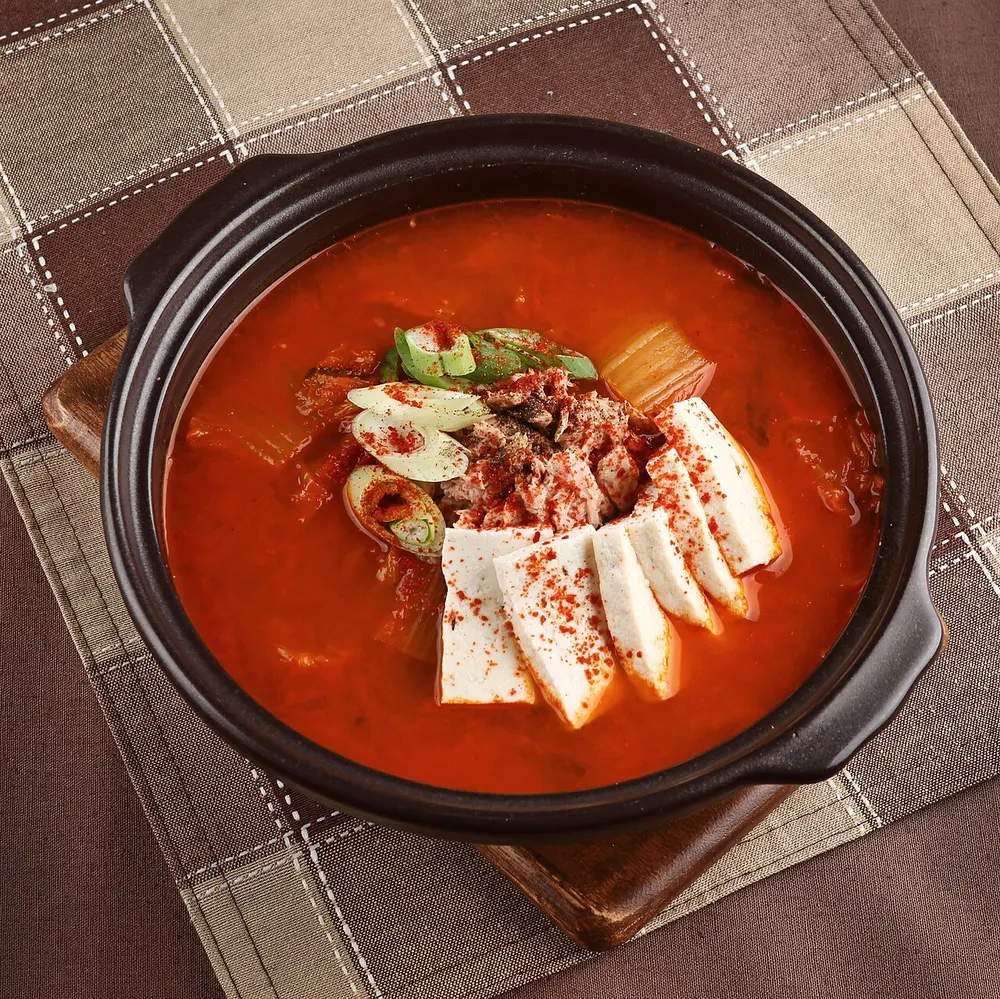
Beginner
Korean
Kimchi Jjigae (Kimchi Stew)
Source: Traditional
30 min3420 kcal
Dairy-free🌶️🌶️
Bulgogi rebuilt with a Chinese chef's hands: the beef is never marinated, it is velveted in starch and egg, flash-fried, lifted out, and only reunited with the sauce in the last thirty seconds.
Source
Recipe by 이연복 · 👨🍳 Chef · Lee Yeon-bok — Chinese-cuisine chef, owner-chef of Mokran (목란)
Names of cooks and creators appear as source credit only. More Recipes Please is independent and is not affiliated with, endorsed by, or sponsored by them.
Lee Yeon-bok (이연복의 복주머니) — Published by Lee Yeon-bok on his own YouTube channel, 이연복의 복주머니, as '호불호 없는 중화불고기' — his most-watched recipe upload at over 127,000 views. The ingredient list and numbered method are printed in full in the video description, and every quantity here is taken from it. Junghwa bulgogi is a Korean-Chinese restaurant dish rather than a mainland Chinese one, which is why it is filed under Korea: a Korean dish rebuilt with Chinese wok technique. His distinguishing move is that the beef is velveted in starch, egg and oil and fried separately, then removed, so the sauce only meets it in the final seconds.
Cook: 이연복
Watch it being made
Cut the top blade into bite-size pieces and put them in a bowl with 1스푼 of mat-ganjang. Work it in with your hands until the soy has disappeared into the meat.
Now add the starch (2스푼), the beaten egg (2스푼) and the oil (2스푼) to the same bowl and massage again until every piece wears a slick, pale coat. Leave it to sit while you do everything else.
💡 This is velveting — the single technique that separates Chinese-restaurant beef from home beef. Starch and egg form a skin that keeps the juices in, and the spoon of oil stops the pieces welding together in the pan. Do not skip the oil.
In a separate bowl mix the sauce: sugar (2스푼), oyster sauce (2스푼), mat-ganjang (1스푼), mirin (3스푼), minced garlic (1스푼) and a pinch of black pepper. Stir until the sugar has dissolved.
💡 Mix it now, not later. Once the pan is hot this dish is over in about ninety seconds — there is no time to be measuring oyster sauce with one hand.
Slice the onion (1/4개) into strips and cut the white part of the green onion (1대) on the diagonal.
Set a pan over high heat and add 3스푼 of oil. Wait until the surface shimmers and moves like water.
Add the coated beef and immediately start stirring it around with chopsticks, breaking up any clumps. Fry 2–3 minutes until no red is left and the coating has set opaque and glossy.
💡 Chopsticks, not a spatula, and start moving the moment it lands. Velveted meat glues itself into a single lump if it sits still for even a few seconds — a spatula is too blunt to separate it once that happens.
As soon as the beef is cooked through, scoop it all out onto a plate and set it aside.
💡 This looks like a pointless extra step and it is the most important one. If the beef stays in for the vegetables and the sauce, it overcooks into rubber. Cooking each element for exactly as long as it needs is basically what wok cooking is.
Put the same pan back on high heat, add the last 1스푼 of oil, and throw in the green onion and onion.
Fry them hard, 1–2 minutes, until the onion has softened at the edges and you can see actual scorch marks — brown-black, catching, just short of burnt. You should smell it before you see it.
💡 He wants them looking 'slightly burnt', which is not the accident it sounds like. Those charred edges are 불맛/wok hei — the smoky note you cannot get from a sauce bottle. Pale, timid onions make a flat dish.
Return the beef to the pan and pour the mixed sauce over it.
Toss everything hard for 30–60 seconds, until the sauce stops looking watery, tightens, and clings to the beef in a shine. Kill the heat there.
💡 The starch already on the beef is what thickens this sauce — you never make a separate slurry. Keep cooking past the glossy point and that same starch turns the sauce to paste.
Turn it straight onto a plate and eat it hot, with rice.
Korean
Source: Traditional
Korean
Source: Home cook
Korean
Source: Home cook
Korean
Source: Traditional
Made this? Share a photo in Showcase.
Share your creation →