Beginner
Korean
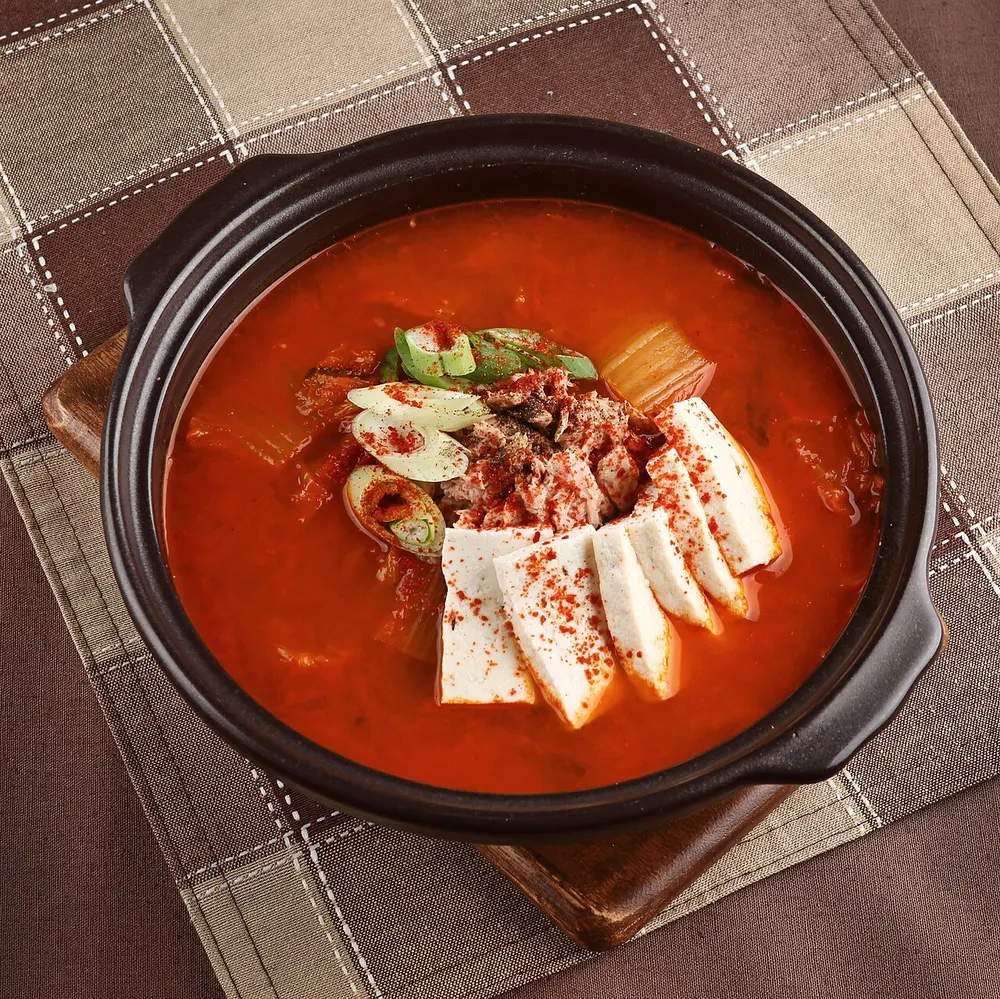
Kimchi Jjigae (Kimchi Stew)
Source: Traditional
30 min3420 kcal
Dairy-free🌶️🌶️
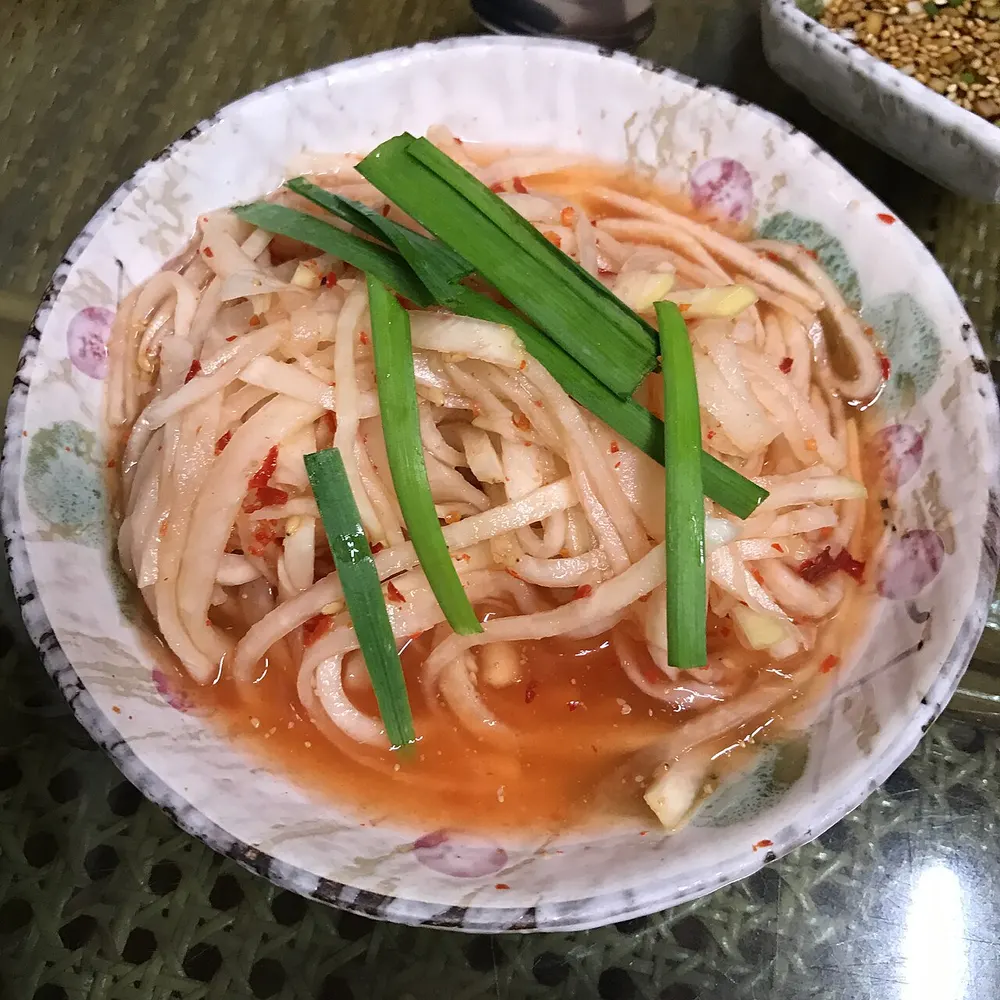
The banchan-shop radish salad with no salt in it anywhere. The radish is cut as thick as a mandoline will go and drawn out in fish sauce and corn syrup instead — so it seasons while it wilts, and the water you throw away is the only thing lost.
Source
Recipe by 김진순 · 📱 Influencer · Kim Jin-sun — Korean cooking YouTuber, '김진순의 점심시간'; former side-dish shop (반찬가게) owner
Names of cooks and creators appear as source credit only. More Recipes Please is independent and is not affiliated with, endorsed by, or sponsored by them.
Kim Jin-sun's Lunchtime (김진순의 점심시간) — Published by Kim Jin-sun on her own YouTube channel 김진순의 점심시간 as '반찬가게 사장님들만 알고있는 전설의 무생채 레시피, 제대로 맛 내려면 소금❌', with the full ingredient list and numbered method in the video description. The distinctive point is in the title: no salt at any stage. The radish is julienned at a mandoline's thickest setting and wilted for 10 minutes in a cup each of sand lance fish sauce and corn syrup, whose liquid is then discarded entirely before the sauce goes on.
Cook: 김진순
Watch it being made
Cut each radish into four manageable pieces.
Using a mandoline set to its THICKEST julienne, cut the radish into batons.
💡 Thickest, not thinnest — she is emphatic. Thin threads of radish go limp and stringy the moment the fish sauce touches them. Thick batons keep a snap all the way through, which is the entire point of 생채 (raw, crisp) as opposed to a pickle.
Put the radish in a big bowl, pour over 1 cup of fish sauce and 1 cup of corn syrup, toss once, and leave it exactly 10 minutes.
💡 No salt anywhere — this is the recipe's headline. Fish sauce and syrup pull water out by osmosis just as salt would, but they leave umami and sweetness behind instead of only salinity. It is why a banchan shop's musaengchae tastes rounder than a home one.
While the radish wilts, make the sauce: combine the gochugaru, 16 tbsp fish sauce, minced garlic, minced ginger, 6 tbsp corn syrup and the MSG in a separate bowl and stir until the chili powder is fully hydrated and glossy.
💡 Let the sauce sit while the radish does. Dry gochugaru needs a few minutes in liquid to swell — mixed in dry, it stays gritty and the colour never blooms.
After exactly 10 minutes, tip the whole bowl into a colander.
Throw ALL of the drawn-out liquid away. Do not save it, do not pour it back.
💡 This is the step people flinch at — you just poured away a cup of fish sauce and a cup of syrup. Keep it and you have a soup, not a salad: the radish has already taken what it needs, and everything left in the bowl is water it rejected.
Return the drained radish to a clean bowl and add all of the prepared sauce.
Toss it thoroughly with your hands until every baton is evenly red, about 1 minute.
💡 Hands, not tongs, and wear gloves. You can feel when a strand is still dry in a way you cannot see, and hands do not bruise the radish the way metal does.
Add the finely chopped green onion.
Scatter over a generous amount of toasted sesame seeds — she says 잔뜩, a lot.
💡 Sesame goes on at the end, after the sauce. Mixed in earlier it soaks up liquid, goes soft and loses the toasty snap it is there for.
Mix once more to distribute the green onion and sesame, then serve. It is ready to eat immediately.
Korean
Source: Traditional
Korean
Source: Home cook
Korean
Source: Home cook
Korean
Source: Traditional
Made this? Share a photo in Showcase.
Share your creation →