Photo coming soon
Beginner
French
Classic French Omelette
Source: Chef
10 min1300 kcal
VegetarianGluten-freeLow-carb+1
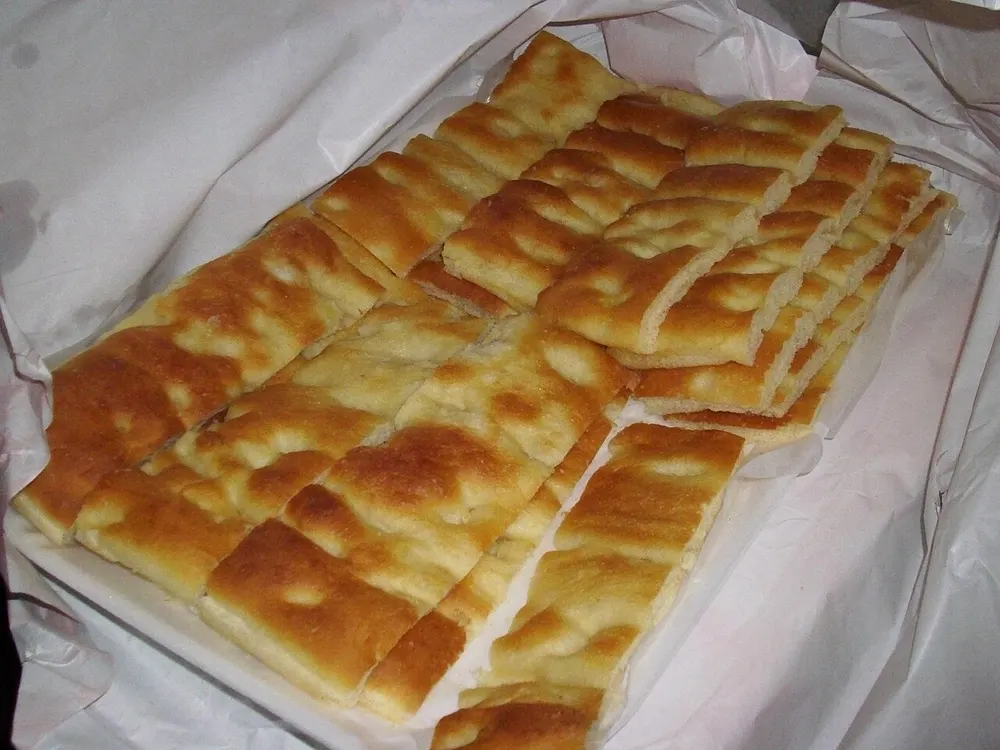
A finger's width of bread, amber on top and full of holes inside, flooded before its last rise with an emulsion of oil, water and coarse salt — the pools it leaves in the dimples are the whole point.
Source
Recipe by Genoese bakeries · 🏺 Traditional · The daily bread of Genoa and the Ligurian coast
Ligurian regional · Genoa — A Ligurian speciality about a centimetre high, golden-amber, with pronounced holes. What distinguishes it is that before the final rise the surface is brushed with an emulsion of extra virgin olive oil, water and coarse salt — the step that produces the pools in the dimples and the colour on top.
Watch it being made · 3 videos
Crumble the fresh yeast into the 180 ml of lukewarm water with the malt, and stir until it dissolves and turns cloudy.
Put the flour in a large bowl, pour in the yeast water and the 20 ml of oil, and mix with your hand until there is no dry flour left. Only now add the 6 g of fine salt and work it in.
💡 Salt straight onto yeast slows it down. Thirty seconds of separation is all it takes to keep the rise lively.
Tip the dough onto the worktop and knead for 8–10 minutes, until it stops tearing and turns smooth, soft and slightly tacky.
💡 Do not add flour to stop the stickiness. A dough this wet is what makes the big holes; flour it now and you will bake a cracker.
Shape it into a ball, return it to the oiled bowl, cover, and leave it in a warm corner for 60–90 minutes, until doubled and domed.
Oil a shallow tin about 20 × 30 cm generously. Tip the dough in and press it out towards the corners with flat hands.
If it springs back and refuses to reach the corners, stop, cover it, and give it 15 minutes before trying again.
💡 Fighting a springy dough tears the gluten you spent ten minutes building. Waiting always wins.
Whisk the emulsion: 30 ml of olive oil, 30 ml of water and the 5 g of coarse salt, beaten with a fork until it goes cloudy and thick.
Press your fingertips straight down through the dough, all over, right to the bottom of the tin — deep, obvious dimples, not shy dents.
💡 Those holes are where the emulsion pools and steams the crumb from inside. Shallow dimples give an ordinary flatbread.
Pour the emulsion over the whole surface so it floods into every dimple. It will look like far too much liquid. It is not.
Cover loosely and prove for a final 30–40 minutes, until the dough puffs up around the pools and the surface looks alive.
Bake at 220°C for 15–18 minutes, until the top is amber — not pale, not brown — and the edges have pulled away from the tin.
Slide it out of the tin onto a rack the moment it comes out of the oven.
💡 Leave it in the tin and the trapped steam softens the bottom crust you just worked for.
Cut it into the wide strips Genoa cuts it into, and eat it warm — ideally within the hour.
French
Source: Chef
French
Source: Traditional
French
Source: Chef
Italian
Source: Home cook
Made this? Share a photo in Showcase.
Share your creation →